The Theotokos
The Mother of God — An Image of Transfigured Humanity
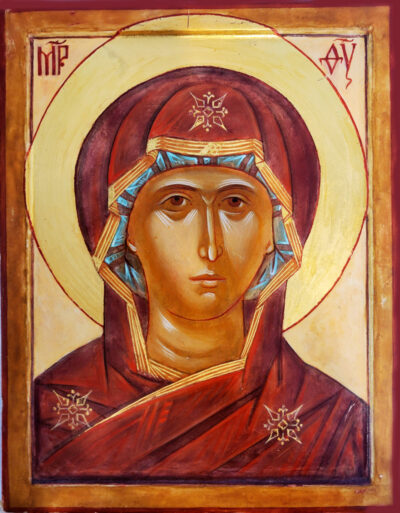
The icon of the Theotokos invites us to contemplate the extraordinary mystery of a human being who became the dwelling place of the infinite and uncontainable God. Her serene presence reveals the spiritual beauty of a life wholly surrendered to divine grace.
Type of Marian Icon: Theotokos
Theotokos means “God-bearer” or “Mother of God” – a term used by early Christians. This title was formally affirmed at the Third Ecumenical Council at Ephesus in 431 and reaffirmed at the Fourth Ecumenical Council at Chalcedon in 451.
In acknowledging Mary the Mother of God, the Church affirmed that the child she bore was one divine person, fully human and fully divine. Mary did not give origin to Christ’s divinity; rather, through her, the eternal Son of God assumed human nature.
Icon Composition & Symbolism
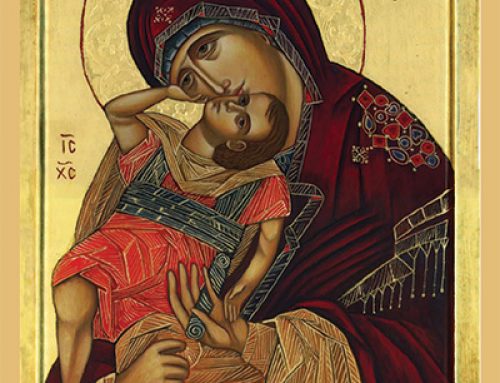
Unlike Marian icons depicting Mother and Child, this composition presents Mary alone, drawing our attention to her spiritual presence and her unique relationship with God.
- The frontal composition: Mary faces us directly, establishing a personal encounter and inviting us into prayer and contemplation.
- The absence of earthly emotions: Her serene expression reflects the transfigured humanity of the heavenly realm. This does not suggest an absence of human feeling, but an interior peace that transcends temporary earthly emotions.
- The large, contemplative eyes: Express spiritual perception—the ability to see beyond the material world and perceive divine realities.
- The small, closed mouth: Symbolizes interior silence, contemplation and prayer, recalling how Mary treasured the mysteries of Christ’s life in her heart (Luke 2:19).
- The deep purple-red garment: Mary’s outer veil, called a maphorion, conveys royal dignity. The blending of red (humanity) and blue (divinity) can also be understood as an expression of the mystery of the Incarnation.
- The blue inner garment: Evokes the heavenly realm and Mary’s participation in divine grace, while reminding us of her humanity.
- The golden borders of her garments: Express her royal dignity as Queen of Heaven and the radiance of divine grace.
- The three stars: Located on her forehead and shoulders, they signify Mary’s perpetual virginity before, during and after the birth of Christ.
- The golden halo & background: Represent the eternal realm and the divine light that sanctifies and transfigures humanity.
- The Greek inscriptions: The abbreviated letters ΜΡ ΘΥ stand for Meter Theou, meaning “Mother of God,” affirming her divine motherhood.
Her Message to Us
Mary is portrayed not as she appeared in earthly life, but in her spiritual transformation. Her inner stillness and serenity reveal the profound peace that comes from complete trust in God. During Advent, her example invites us to cultivate interior silence, surrender our anxieties and prepare our hearts to receive Christ.
Through the hand of Kathy Sievers, Iconography Instructor of the Classical Iconography Institute
Leave A Comment
You must be logged in to post a comment.