
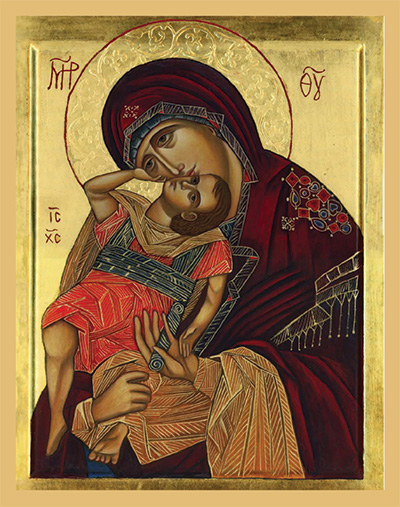
Panagia Kecharitomene
Full of Grace — Acceptance of Divine Grace & Anticipation of Christ’s Passion
The Panagia Kecharitomene (All-Holy Mother, Full of Grace) is based on a 13th-century icon located at the Monastery of Xenophontos on Mount Athos, Greece. The extraordinary intimacy between Mother and Child reveals divine love, human vulnerability and prophetic sorrow.
Type of Marian Icon: Eleusa
This icon belongs to the Eleusa (Tenderness) tradition, characterized by the cheek-to-cheek embrace of Mother and Child. Its title, Kecharitomene, recalls the greeting of the Archangel Gabriel at the Annunciation: “Rejoice, full of grace, the Lord is with you.”
Unlike the more serene compositions of other Eleusa icons, the Kecharitomene conveys a remarkable emotional intensity, foreshadowing Christ’s Passion.
Icon Composition & Symbolism
The dynamic s-shaped curves of the composition draw our attention to Christ’s unusual posture, revealing the relationship between the Incarnation and His future sacrifice.
- Mary’s expression:Conveys “bright sadness”—the profound joy of maternal love mingled with prophetic sorrow, knowing the suffering that awaits her Son.
- Christ’s loving touch:The Christ Child reaches toward His mother’s face, expressing the extraordinary tenderness with which God reaches out to humanity.
- Christ’s twisted posture:His reclining body and clinging grasp introduce a sense of tension and emotional intensity, foreshadowing His suffering on the cross.
- Mary’s supporting hand:Her tender grasp of Christ’s foot expresses maternal protection and affection.
- The closed scroll:Held in Mary’s hand, the scroll recalls the divine message entrusted to her at the Annunciation and her acceptance of God’s plan for salvation.
- Christ’s luminous garments:The delicate golden lines evoke divine glory radiating from within.
- Mary’s purple garment:The blending of red (humanity) and blue (divinity) evokes the mystery of the Incarnation.
- The ornamental stars:Signify Mary’s perpetual virginity before, during and after Christ’s miraculous birth.
Her Message to Us
Especially meaningful during Advent, the Kecharitomene brings together the joy of the Annunciation and the prophetic sorrow of the Passion. Mary’s acceptance of God’s will embraces both the extraordinary privilege of bearing His Son and the suffering that will accompany her motherhood.
Through her example, we are invited to open our hearts to divine grace, trusting in God’s plan even when we cannot fully comprehend it. In the tender embrace of Mother and Child, we discover the immeasurable love of a God who willingly makes Himself vulnerable for our salvation.
Through the hand of Laurie Muench, Iconography Instructor of the Classical Iconography Institute
Leave A Comment
You must be logged in to post a comment.