
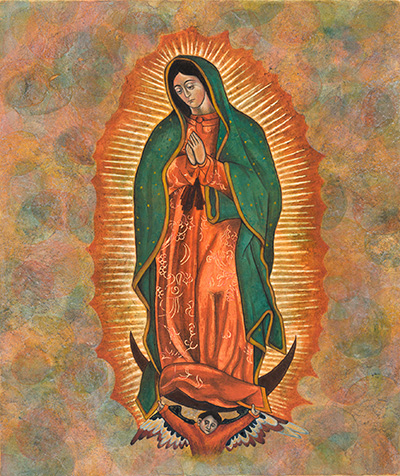
Our Lady of Guadalupe
A Mother Who Unites Heaven & Earth
Our Lady of Guadalupe is one of Christianity’s most mysterious sacred images and was the catalyst for one of the largest conversion to Christianity in the Americas. Her image embodies layers of symbolism that have mystified believers and scholars for nearly five centuries. According to tradition, the image miraculously appeared on the tilma (cloak) of an Indigenous peasant, Juan Diego, on December 12, 1531, her feast day.
The image is a blend of Indigenous Mexican culture and European Christianity. Many extraordinary physical characteristics have led to its classification as “a sacred image not made by human hands.”
Type of Marian Image: Acheiropoietos
Our Lady of Guadalupe is called an Acheiropoietos icon or image, a Greek term meaning “not made by human hands.” This designation is given to sacred images believed to be of miraculous origin rather than the work of a human artist.
Unlike traditional Byzantine Marian icons, Our Lady of Guadalupe presents the Virgin Mary without the visible Christ Child. Yet the symbolism of the image reveals her as the Mother of the incarnate Son of God, making it particularly meaningful during Advent.

Icon Composition & Symbolism
One of the most unique aspects of this icon is its ability to communicate Christian theological truths through a visual language familiar to both Indigenous and European cultures. Every element offers an opportunity to contemplate the mystery of the Incarnation and Mary’s role in salvation history. The Vesica Piscus (right) is the structure of its underlying geometry, symbolizing spiritual birth or enlightenment.
- The golden ratio:The proportions of Mary’s body and the positioning of key elements, including the relationships between her head, hands, waist and feet, have been interpreted as reflecting the golden ratio. This mathematical proportion, found in nature, classical art, iconography and sacred architecture, is associated with harmony, beauty and the underlying order of creation.
- The Vesica Piscis:The underlying geometry of the composition can be understood through the Vesica Piscis, an almond-shaped form created by the intersection of two circles. In Christian sacred art, this form evokes the meeting of heaven and earth, divine manifestation and spiritual birth. Here, it invites contemplation of Mary as the one through whom God entered human history.
- Mary’s complexion:The Virgin is presented as mestiza, with an olive complexion and features that bridge Indigenous and European ancestry. At a time of profound cultural division, her appearance conveyed a powerful message of unity, reconciliation and universal motherhood.
- The crescent moon:Mary stands upon a crescent moon, a symbol that resonates with Indigenous Mexican celestial imagery and associations with the Aztec moon goddess. For Christians, it recalls the Woman of the Apocalypse described in Revelation 12:1: “A woman clothed with the sun, with the moon under her feet, and on her head a crown of twelve stars.”
- The golden rays:The luminous rays surrounding Mary recall the Woman of the Apocalypse while also speaking to a culture in which the sun held profound religious significance. Mary is surrounded by light but is not herself its source, directing our attention toward the divine light of Christ.
- The starry mantle:Mary’s blue-green mantle evokes the heavens and divine majesty. Some researchers have proposed that the arrangement of its stars corresponds to the constellations visible over central Mexico on December 12, 1531, the traditional date on which the image appeared. This interpretation suggests an extraordinary relationship between the sacred image and the celestial order.
- Mary’s downcast eyes:Her gentle, lowered gaze conveys humility, modesty and maternal compassion. Rather than presenting herself as a deity, Mary reveals herself as a humble servant of God.
- Her prayerful hands:Joined in prayer, Mary’s hands express reverence, devotion and submission to divine authority. Her gesture reminds us that she directs our worship toward God rather than toward herself.
- The black sash:Traditionally interpreted as an Indigenous sign of pregnancy, the sash around Mary’s waist reveals that she carries the Christ Child within her womb. Although Christ is not visibly depicted, His presence is central to the theological meaning of the image.
The Tilma — An Enduring Mystery
The original image appeared on Juan Diego’s tilma, described as a cloak woven from coarse cactus or agave or “basta” fibers. Basta fiber have a lifespan of about 50 years, yet the tilma has remained remarkably preserved for nearly five centuries.
Scientific examinations of the fibers report unusual characteristics that continue to generate considerable debate.
- Longevity of the fibers:this is particularly remarkable given the fragility of its material and its long history of public veneration.
- Absence of brushstrokes:some examinations reported that portions of the image appear to lack visible brushstrokes associated with painted images.
- Extraordinary coloration:some observers have described the pigmentation to appear to emanate from within the fibers rather than simply resting upon their surface.
- The mystery of Mary’s eyes:photographic, infrared and magnified examinations have claimed that tiny, reflected human figures are reflected within Mary’s eyes. Some interpreters believe these figures represent individuals present when Juan Diego revealed the miraculous image to the bishop.
- The celestial arrangement:the proposed correspondence between the stars on Mary’s mantle and the heavens at the time of the apparition leads experts to believe that this image reflects a divine order that transcends ordinary artistic ability and composition.
Her Message to Us
Our Lady of Guadalupe appeared during a period of fcultural upheaval and division. Her image spoke simultaneously to Indigenous and European communities, highlighting Mary as a powerful symbol of reconciliation, compassion and spiritual unity.
The devotion surrounding Our Lady of Guadalupe became a catalyst for one of the most remarkable periods of conversion to Christianity in the Americas. Today, she remains one of the most revered Marian images in the Christian world and a beloved expression of Mary’s universal motherhood.
Particularly meaningful during Advent, Our Lady of Guadalupe invites us to contemplate Mary as the bearer of the incarnate Son of God. The underlying geometry, celestial imagery and symbolism of pregnancy all draw us toward the mystery of heaven and earth united through the Incarnation.
Through her maternal presence, we are reminded that God draws near to every people, meeting every person within their own culture, language and circumstances. Her image assures us that no one is excluded from the tenderness of divine love and the promise of salvation.
Through the hand of Kati Reyes, Iconographer of the Classical Iconography Institute
Leave A Comment
You must be logged in to post a comment.