
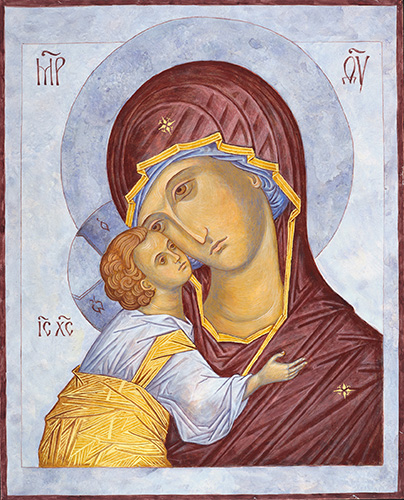
Our Lady of Vladimir & Riza
An Image of Divine Tenderness
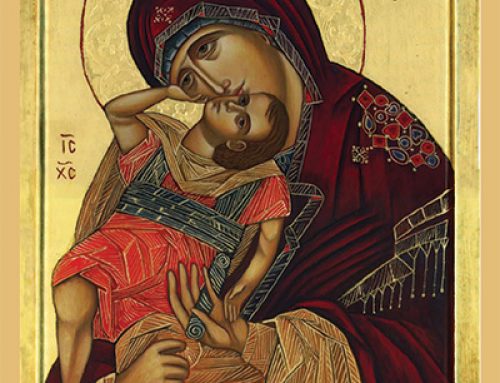
Among the most beloved Marian icons, Our Lady of Vladimir invites us to contemplate the mystery of the Incarnation through the tender embrace of a mother and her child.
Originating in Constantinople in the 12th century, the icon was brought to Kiev and later to the city of Vladimir. According to tradition, the horses carrying the sacred image stopped near Vladimir and refused to continue, giving the icon its enduring name.
Type of Marian Icon: Eleusa
The Greek word Eleusa means “tenderness” or “mercy.” In this type of Marian icon, the Christ Child presses His cheek against His mother’s, His small arm lovingly embracing her neck. This intimate gesture reveals not only maternal affection but also the depth of God’s love for humanity.
Icon Composition & Symbolism
The underlying geometry of this Eleusa composition forms a graceful S-shape, drawing Mother and Child into an intimate embrace.
- Mary’s gaze: While Christ looks lovingly toward His mother, Mary looks outward toward us, inviting us to share in the mystery of divine love.
- Mary’s expression: Her large, soulful eyes convey what is described as “bright sadness”—the ability to simultaneously hold the profound joy of maternal love with prophetic sorrow, knowing the suffering that awaits her Son.
- The touching cheeks: The physical intimacy of Mother and Child expresses the mystery of the Incarnation—God entering into the fullness of our human experience.
- Christ’s embrace: His arm encircling Mary’s neck reveals the extraordinary humility of the infinite God, who willingly becomes dependent upon His human mother.
- Christ’s exposed foot: The visible sole of His foot emphasizes His physical humanity and vulnerability and may also be understood as an anticipation of His Passion.
- The Christ Child’s garments: Although an infant, Jesus wears the robes of a philosopher, signifying His eternal wisdom and divine authority.
- Mary’s purple garment: The blending of red (humanity) and blue (divinity) evokes the mystery of the Incarnation.
- The three stars: Traditionally placed on Mary’s forehead and shoulders, they signify her perpetual virginity before, during and after Christ’s miraculous birth.
Her Message to Us
In the loving embrace of Mother and Child, we contemplate the humanity and divinity of Christ. Here, the infinite God makes Himself vulnerable, revealing the extraordinary tenderness of divine love for humanity.
The Riza — A Garment of Honor
This magnificent, hand-beaded covering, called a riza, was embroidered to adorn this specific icon. For centuries, Christians have expressed their devotion by clothing sacred images in beautifully crafted coverings of gold, silver, enamel, pearls and precious stones.
The materials convey the radiance of holiness: silver evokes spiritual purity, gold signifies divine light and blessing, while gems and pearls suggest the richness and many facets of holiness.
A riza also serves a practical purpose, protecting the painted icon from candle soot and the smoke of oil lamps burning before it. Each covering is individually designed, leaving exposed the areas traditionally venerated—the face, hands and feet.
As we contemplate the embrace of Our Blessed Mother and her Son, we discover a God who comes to us with tenderness, mercy and immeasurable love.
Through the hand of Alice Bolgova, Iconographer & Instructor of the Classical Iconography Institute
Leave A Comment
You must be logged in to post a comment.