
The Resurrection Icon
A Symbol of Hope from the Chora
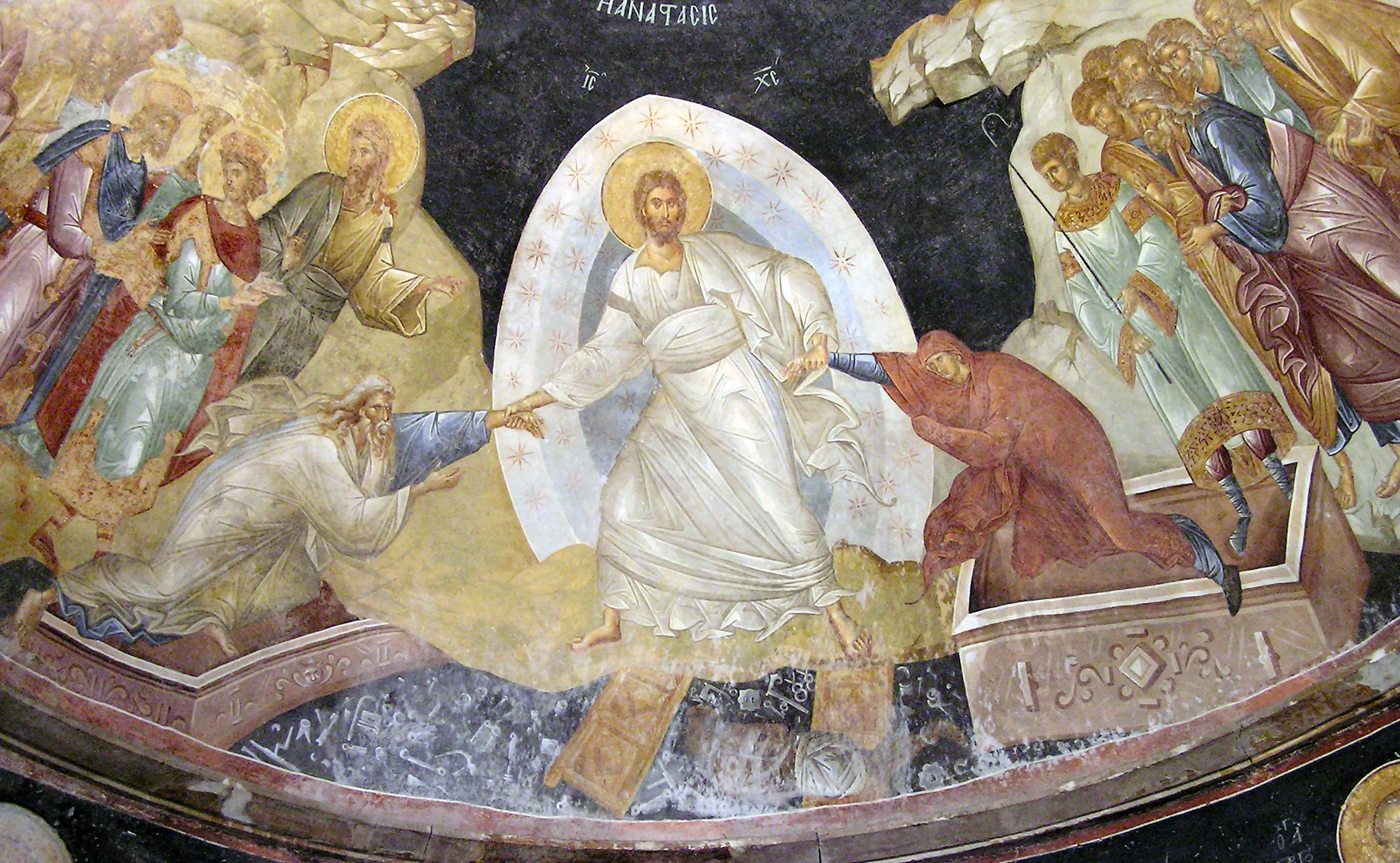
The Anastasis (Resurrection / Harrowing of Hades / Descent into Hades) icon is one of the most theologically rich images in iconography. Across Greece, Russia, the Balkans, and Constantinople, its visual elements remain remarkably consistent—even though they are not derived directly from the canonical Gospels.
So Where Did These Visual Elements Originate?
The event we see in the Anastasis is the visual representation of what is described in the extra-canonical Gospel of Nicodemus (also called the Acts of Pilate – linked text here) especially in the section called the Descent into Hell. The conversation in this writing takes place between Satan and Hades, or the collective demons in the underworld.
The Anastasis fresco shown here was painted between 1315-1321 and is one of the most famous Resurrection images. We find it in Istanbul inside The Chora.
Images We See First
- Christ pulling Adam and Eve by the wrists
- Boards under Christ’s feet
- Groups of Kings, Prophets & Patriarchs
- A bound figure
What These Symbols Mean
Christ Pulling Adam & Eve by the Wrists
Christ grabs Adam and Eve by the wrists, lifting them from their tombs. Pulling them up by their wrists depicts:
- Divine Initiative: Salvation is entirely God’s action; humanity does not “reach up.” This is not a partnership.
- Total Dependence: The limp hands of Adam and Eve emphasize human inability to save itself.
- Universal Representation: as Adam represents all humanity (the “Old Adam”).
- Resurrection: Rising from sarcophagi signifies real transformation.
Christ as the New Adam restores fallen humanity, “As in Adam all die, so in Christ shall all be made alive” (Rom 5; 1 Cor 15)
Boards Under Christ’s Feet
Christ stands on what appears to be two boards, sometimes also depicted as crossed which represent the bronze gates to Hades that have been broken by his descent to Hades. Typically, we also see broken locks, bars & chains underneath these shattered gates.
- The gates beneath His feet signify decisive victory and storming of Hades.
- Scattered locks and keys indicate that death’s hold on power is broken.
- The Cross, as the instrument of death is also the very means of liberation and the key that opens Hades.
From the Gospel of Nicodemus:
Hades and Satan attempt to secure the gates to Hades with locks, bars and chains; however, Christ descends and breaks them open, liberating the righteous dead from their tombs. Christ has destroyed death from within.
Groups of Kings, Prophets & Patriarchs
The people on either side of Christ typically include King David, King Solomon, Moses, Abel, St. John the Baptist and various other patriarchs and prophets.
- David & Solomon: symbolize the royal lineage of Christ.
- St. John the Baptist: continues his role as Forerunner showing the way, even in Hades.
- Abel: is the first righteous victim who is now vindicated.
- Various Patriarchs & Prophets: are shown awaiting the Messiah.
These people show us that salvation extends beyond time and that Christ comes to redeem those who have died in the past, in the present and those who will die in the future.
The Bound Figure
In the dark abyss beneath Christ who stands on the shattered gates of Hades, we often see a bound or crushed dark figure. This is Satan/Hades who has been defeated by Christ and is entangled by his own chains.
- This shows the defeat of the “Strong Man” (cf. Matthew 12:29 – “Or how can anyone enter a strong man’s house and steal his property, unless he first ties up the strong man? Then he can plunder his house.“)
- Broken chains mean that death no longer has power over us.
- The dark abyss has been penetrated by divine light.
Christ doesn’t just come down and free the dead, he overthrows the ruler of Hades.
The Anastasis icon represents the fulfillment of the Resurrection and confirms that Christ descends to Hades to enter into the full depth of the Fall. He confronts Hades and He prevails. He liberates the righteous dead and He restores humanity – Christ doesn’t rise alone; He depicts humanity rising in Him.
What Does Chora Mean?
“Chora” is defined to mean countryside, suburbs, or township suggesting that the Chora Church was named for its location outside the city limits of Constantinople. However, one could argue that the Chora Church was not simply named for its surroundings, instead for a philosophy described in Plato’s Timaeus. That concept can be applied to describe the Virgin Mary and Christ, specifically in relationship to the Chora. Let’s touch on that deep concept.
The Philosophy of Chora
Chora is a complex philosophy that could be simplified to mean receptive space, a place where the uncontainable becomes present – a screen that allows things to appear. In Christian theology and Byzantine tradition, Chora (Greek: χώρα, meaning “land,” “space,” or “receptacle”) represents a sacred space or vessel and is used to describe Mary as the “Container of the Uncontainable” and Christ as the “Land of the Living,” signifying the threshold between the divine and earthly.
A paper written by scholar Alexander Lidov (specialist in Byzantine Iconography), “Icon as Chora: Spatial Aspects of Iconicity in Byzantium and Russia” argues that the icon functions as a sacred space where the divine presence is made perceptible through non-naturalistic space – especially reverse perspective – transforming the viewer from observer into participant. In this case, the icon is “Chora.”
The Chora in Istanbul
To learn more about the images inside The Chora in Istanbul (including the fresco discussed in this post), here is a link to an engaging 9 minute video presentation written by Dr. Evan Freeman (Professor, Hellenic Studies at Simon Fraser University in British Columbia): Click here to view the 9 minute video: About the Chora.
Learn about Chora
- Learn more about “Chora” through icons by studying this ancient, sacred liturgical art at the Classical Iconography Institute. Visit our website for classes and upcoming lectures.
- You are welcome to join us in Fall when we will visit “The Chora” in the last two days of the “Divine Light – Sacred Art Pilgrimage” this September 26 – October 9, 2026.

Leave A Comment
You must be logged in to post a comment.