
The Kardiotissa
Two Hearts United in Sacrificial Love
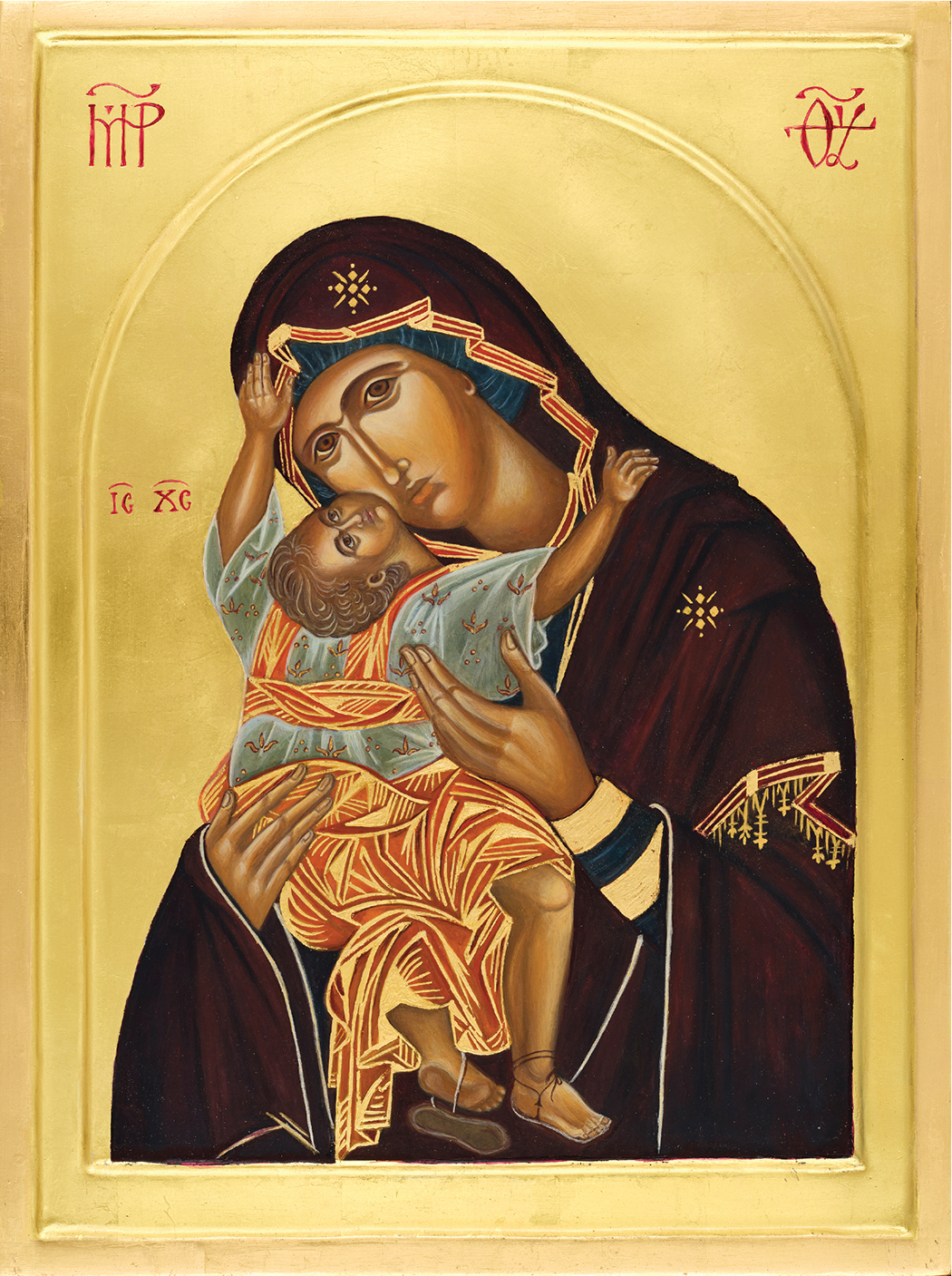
The Kardiotissa, based on a 15th-century Greek icon, invites us to contemplate the intimate relationship between Our Blessed Mother and her Son, united not only in maternal love but also in the mystery of Christ’s future sacrifice.

Type of Marian Icon: Eleusa, subgenre Kardiotissa
Derived from the Greek word kardia, meaning “heart,” the Kardiotissa belongs to the Eleusa (Tenderness) tradition of Marian icons. Its composition reveals a deeper sacrificial emphasis, uniting the mysteries of the Incarnation and Crucifixion, collapsing time in one moment.
Icon Composition & Symbolism
Fittingly, the underlying geometry of this composition forms a heart, visually uniting Mother and Child in tender, merciful and sacrificial love.
The Christ Child’s Outstretched Arms
With the exception of the crucifixion, we rarely see Christ’s bare arms and legs in icons, yet in this icon they were prominently exposed. This unusual detail inspired me to ask, why? In my research I discovered that this icon may be understood to be the reverse crucifixion of Christ on the heart of His mother. Kardiotissa means tender, merciful heart and here both hearts of mother and Child are united.
The Prophecy of Simeon
The sacrificial nature of this icon is a mirror of the future, reminding us of the prophesy of Simeon when the Holy Mother heard that a sword would pierce her heart. The Kardiotissa gives visual expression to this prophesy. Christ’s raised arms foreshadow His posture on the cross, except in this icon, His divinity is nailed to the body of our Holy Mother. “I therefore call the Mother of God a cross,” said one of the Church Fathers, “for the Lord was suspended on her outstretched arms.”
A Dangling Sandal
The dangling sandal is intended to remind us of the Flight into Egypt. It also emphasizes Christ’s true humanity: the eternal Son of God has entered a world of danger, suffering, and mortality.
Mystery Beyond Time
In the eschatological realm depicted in icons, there is no need for the human construct of space and time, so icons often present multiple events and concepts simultaneously in non-chronological or systematic order. Witness here the compression of time represented by the dangling sandal – reminding us of the flight into Egypt; the Christ child as infant – reminding us of Christ the King’s humble birth; and the Blessed Virgin Mary’s body as the locus of the Divine Self-Emptying, where God took human form and became “obedient to the point of death, even death on a cross.” (Philippians 2:8).
Christ’s outstretched arms
Rarely are Christ’s bare arms and legs so prominently exposed in icons outside the Crucifixion. His unusual posture foreshadows His position on the cross, inviting us to contemplate this image as a “reverse Crucifixion”—Christ crucified upon the heart of His mother.
The heart of Mary
The composition gives visual expression to the prophecy of Simeon that a sword would pierce Mary’s own soul (Luke 2:35). Her body, which once bore the incarnate God, becomes a visual anticipation of the cross.
Mystery beyond time
Icons transcend the earthly limitations of space and time, allowing multiple sacred events to be presented simultaneously. Here, Christ’s infancy, the Flight into Egypt and His future Crucifixion are brought together in a single image.
The heart-shaped geometry:Expresses the profound union of the hearts of Mother and Child, inseparable in love and suffering.
Her Message to Us
Especially relevant during Advent, the Kardiotissa invites us to contemplate the mystery of divine self-emptying: the infinite God who took human form and became “obedient to the point of death, even death on a cross” (Philippians 2:8).
In the tender embrace of Mother and Child, we witness a love that is inseparable from sacrifice. Mary’s heart becomes a place where the joy of the Incarnation and the sorrow of the Passion meet. Let us contemplate the immeasurable depth of divine love for humanity.
Through the hand of Christine Thum Schlesser, Executive Director of the Classical Iconography Institute
Leave A Comment
You must be logged in to post a comment.