

Today, Christians throughout the world commemorate the conclusion of the Virgin Mary’s earthly life.
In the Western Church, this solemnity is called the Assumption of the Virgin Mary, emphasizing her bodily entrance into Heaven without undergoing death.
In the Eastern Church, it is known as the Dormition of the Theotokos—“Theotokos” being the Greek title meaning God-bearer or Mother of God. Here, the focus shifts: Mary undergoes a peaceful, natural death (“falling asleep in the Lord”) before her soul and, ultimately, her body are received into eternal glory.
Because the Eastern Church often follows the Julian calendar, the Dormition is observed on what corresponds to August 28 in the Gregorian reckoning. Despite these chronological and theological nuances, both traditions proclaim the same central truth: Mary now shares fully in the resurrection with her Son.
Liturgical Space as Catechesis
In ancient Christian Church architecture, the altar faces east, toward the rising sun—a cosmic and eschatological symbol of Christ’s second coming.
The Dormition is traditionally painted on the western wall, the side of the church that worshippers see as they exit. This placement is deliberate: the faithful leave the Liturgy with an image of Mary’s peaceful death, a visual reminder that earthly life is a pilgrimage toward resurrection.
The Dormition of the Theotokos – St. Markov Monastery (N. Macedonia)
This photograph of the Dormition was taken during the 2023 Sacred Art Pilgrimage to the Balkans at St. Markov Monastery in North Macedonia. This image offers a a richly layered theological composition. During the pilgrimage, the St. Markov Monastery priest succinctly explained, “This is the last image you see, so it will be the last thought you carry with you.”
The scene unfolds in three registers—earthly, miraculous, and heavenly—each saturated with symbolic meaning.
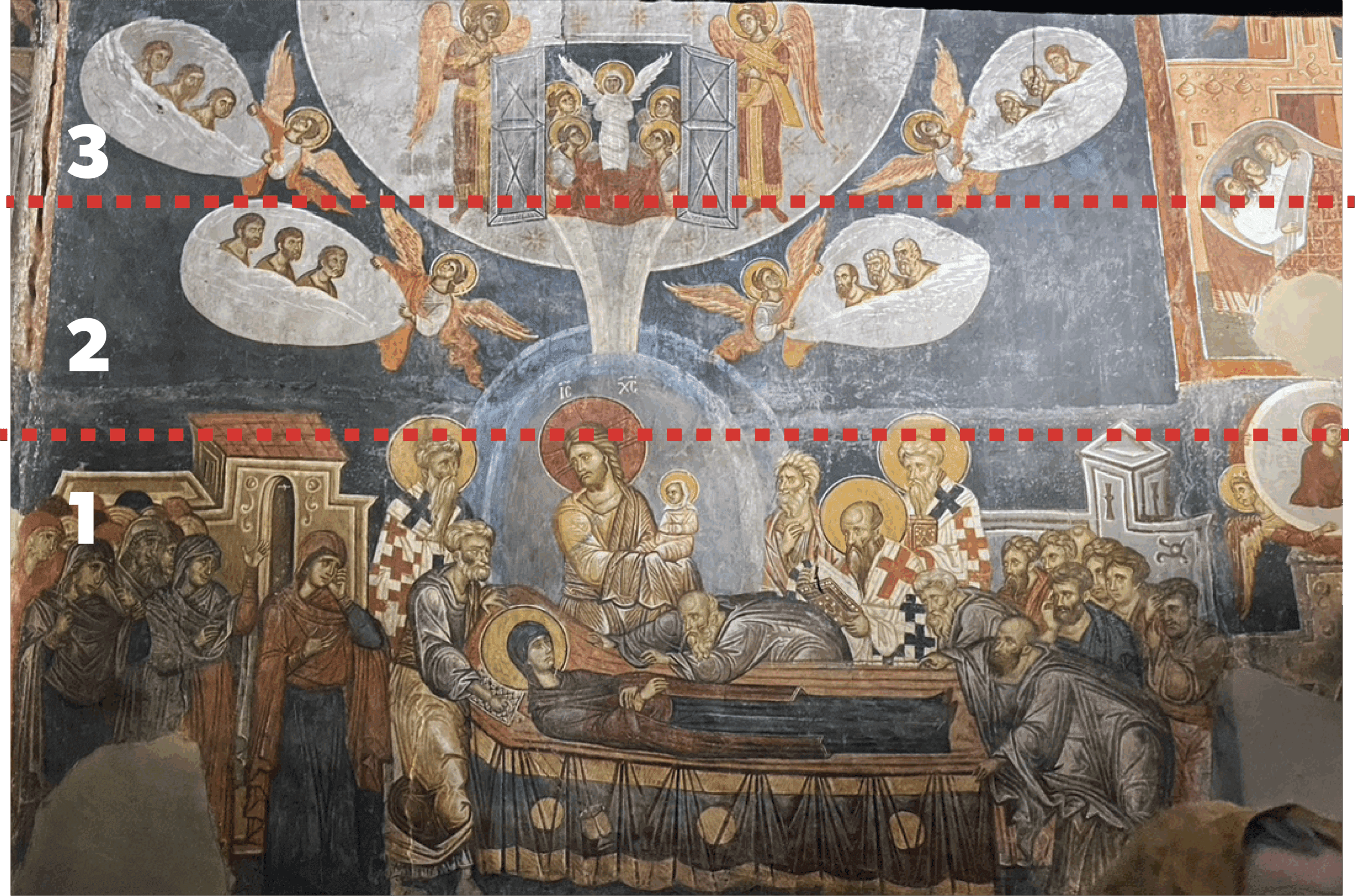
1. Lower Register: Earthly Mourning
At the center, the Theotokos lies in repose upon a bier—a liturgical platform draped with an embroidered cloth used for veneration. Her face is serene, her body radiant, symbolizing incorruption.
The Apostles stand around her. Though historically absent from the event, St. Paul is shown here to emphasize theological, not historical, truth. Iconography collapses temporal and spatial boundaries, so the Apostles appear again in the same icon, participating in events that occur at different moments.
2. Middle Register: The Miraculous Gathering
Here is the part of this iconographic wall program that creators of the Ancient Aliens series used as evidence of aliens arriving on Earth – see the small, airborne figures in the sky that seem to be inside shell-like vessels? Yes, those were misinterpreted to be spaceships!
In reality, shapes like this are a common device in iconography called a “Cartouche” and the “Miraculous Gathering” is a common Dormition motif. The cartouches are a purely symbolic device to direct our attention to the Apostles’ supernatural transport to Jerusalem. Think of these cartouches like visual “thought bubbles,” indicating mystical realities beyond ordinary sight.
3. Upper Register: The Heavenly Welcome
Even though Christ seems to be standing in the lowest register, the Mandorla signifies that he is in Heaven, standing above the Virgin Mary, cradling a small, radiant, swaddled figure—Mary’s soul—within His arms. This soul is often shown as a child to indicate purity and newness of life. In the St. Markov Dormition, Mary’s soul is given wings at the very highest register, borrowing from angelic imagery to express her complete sanctification. Archangels open the gates of Heaven, and ranks of angels lift her soul upon a red cloth—an honorific sign recalling liturgical processions.
Sacred Geometry and Theological Symbolism
Christ and Mary’s soul are enveloped in a mandorla—an almond-shaped full body halo formed by two intersecting circles, a geometric figure known as the Vesica Piscis. This form, central to Christian sacred geometry, symbolizes the union of Heaven and Earth and is found in both the Incarnation and resurrection narratives. The Vesica Piscis is also the basis for the ancient Christian fish symbol (ichthys), linking this image to the earliest visual confessions of faith, painted in the catacombs during the Christian persecutions.
Theological Message
The Dormition imagery is not merely narrative; it is doctrinal proclamation in visual form. It affirms:
- The immediacy of divine reception for the righteous.
- The hope of bodily resurrection at the consummation of time (eschaton).
Placed on the western wall of a church, the image functions as a memento vitae aeternae—a reminder of the believer’s journey toward eternal life, with Mary as the first to follow Christ in resurrection glory.
Iconography as Theology in Color
Whether one speaks of Dormition or Assumption, the theological core is the same: Mary is a sign and forerunner of the destiny promised to all in Christ. In pigment, gold, and carefully composed form, the St. Markov Monastery Dormition invites us not only to contemplate an event in sacred history, but to see in Mary’s “falling asleep” a vision of our own hopeful awakening in the Kingdom of God.

Leave A Comment
You must be logged in to post a comment.