
Welcome! The sacred images before you are the culmination of a deep, year-long journey. The students of the Institute spent a full year meticulously researching the history, theology, and traditional iconography of their chosen Saint, learning to draw them with precise reverence before ever touching brush to board.

In the process, our students uncovered a wealth of profound historical details and spiritual insights that could not fit onto a gallery label. If the icon you’re viewing has a QR code with a circled I, it indicates there is extended information for it, which you can find here.
We invite you to read on, explore the depths of this sacred art, and step closer into the stories that inspired our students throughout this past year.
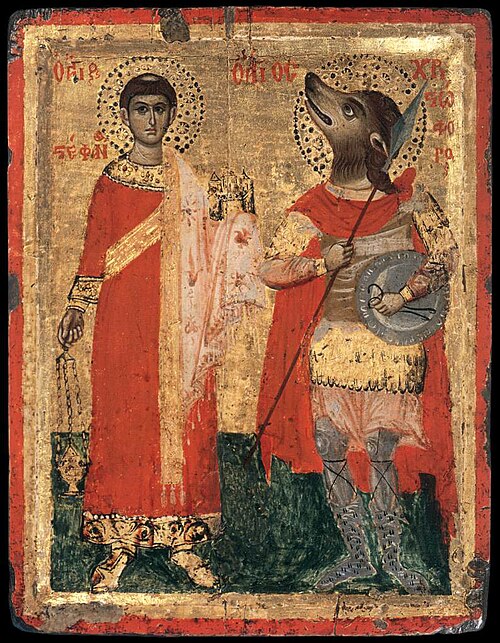
Saint Christopher | Cynocephali
Otherness – Difference – The Foreigner
The cynocephali tell us something about how medieval European thinkers conceptualized
otherness, difference & foreigners. We know that “dog” was a common slur against non-
Christians.
According to Christian tradition, Christopher encountered Christ, carried Him across the waters,
and was transformed by that encounter. The dog-headed Christopher came to symbolize the
outsider – the foreigner, the pagan, the one perceived as different. Yet he became a saint.
We featured the 17 th century icon of St. Christopher dressed in luxurious robes, with human
hands, flowing locks, and an unmistakable snout because it poses a question that lies at the
heart of this exhibition: What happens when Christ calls someone to sainthood?
While not everyone will agree on this icon’s interpretation, we believe it is worthy of study as
part of the rich and sometimes unexpected history of Christian sacred art.
The image has often been understood as expressing the transformative power of Christ, who calls all
people—including those perceived as foreign, different, or outside the boundaries of society—to
holiness, expressing the ultimate goal of Christianity.
If you would like to learn more, The Orthodox Arts Journal published a two-part article dedicated to this image that elaborates. (linked here). JSTOR discusses the Cynocephalli in history:

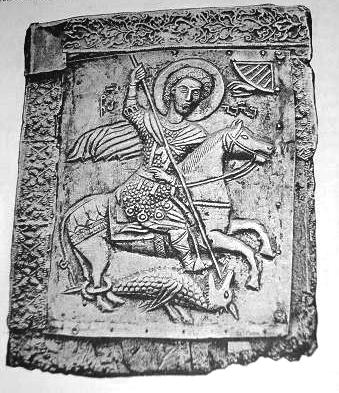
Icon of Saint George and the dragon from Likhauri (Ozurgeti Municipality), Georgia, 12th century
St. George
The veneration of St. George dates from no later than the 5th century while the earliest collections of his intercessory miracles appeared in medieval times. The earliest source for the legend of St. George’s slaying a dragon in Silene, Libya to save the life of the king’s daughter dates from an 11th-century Georgian source. It came into English through the 15th century translation of William Caxton, who brought the printing press to England. Stories about St. George abound around the Mediterranean. Not surprisingly, some of those in Greece parallel stories from classical mythology.
In Arabic, St. George is known as Mar Jirjas and often referred to as “al-Khadr,” meaning ‘The Verdant [One],’ and the color green shows up in icons and popular Muslim representations of him. In the Levant, he is venerated by Christians, Druze, and Muslims; in some locales, Jews during earlier periods also venerated him. Narratives about him often draw on strands from Christian, Muslim, and earlier mythical sources. Al-Khadr, a small community just outside Bethlehem, is home to a Greek Orthodox monastery where locals believe St. George was born and later imprisoned; the chains in which he was restrained remain there as relics that are said to have healing power. As late as the early 20th century, Christians, Muslims, and Jews with psychiatric conditions were brought there to be blessed. Even now, there is an annual pilgrimage to the site in which Christians and Muslims participate. A century ago, Bethlehem Christians used the expression “By the truth of al-Khadr” to insist on the validity of something they were saying, and today, some Christians and Muslims still cry out, “Oh, Khadr!” when there is an accident, seeking the saint’s intercession. It would be difficult to find a Palestinian Christian home that does not contain an icon of St. George, and stone images of him slaying the dragon are often found above the entryway to Christians’ homes.
This icon has long appealed to me because of its serene elegance. During 2018-19, I taught at Bethlehem University in the West Bank and came to have a much deeper appreciation of icons, their meanings for believers of all faiths there, and the role of St. George in the life of Palestinians, in particular. I also worshiped weekly at St. George’s Anglican Cathedral in Jerusalem, which is the seat of the Episcopal Church in Jerusalem and the Middle East.
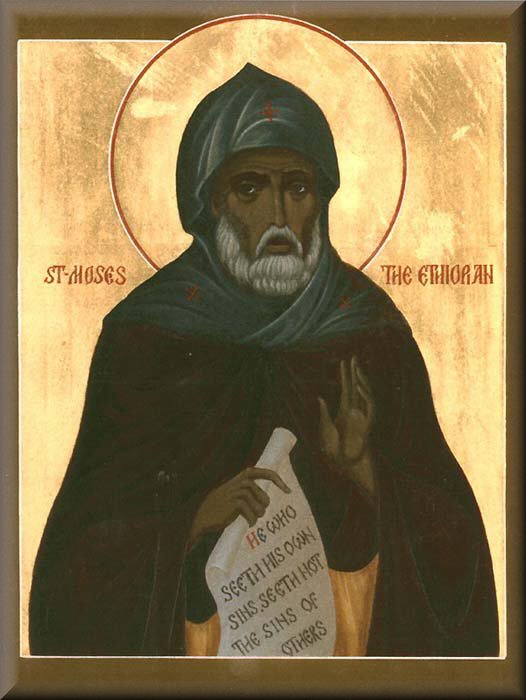
St. Moses the Black, Image via Fundación La Buena Noticia
St. Moses the Black
I was struck by how 4th century struggles are still struggles today. Written accounts describe St. Moses the Black as a large, imposing man with the darkest black skin. In fact, “Ethiopian” in Classical Greek means “burnt skin,” referring to peoples living south of Egypt, generally in Nubia or regions corresponding to modern day Sudan and Ethiopia. His skin color became the source of discrimination and was used as the means to “proof” him before considering his readiness for priesthood.
The abbot of his monastery orchestrated deliberate taunts concerning Moses’ blackness, equating the darkness of his skin with sin, an affront that would have been met with violence earlier in his life. After calmly enduring this chastisement, he was asked if it made him angry. Moses replied that he was upset but had learned how to calm his anger impulse through humility. The Abba was satisfied that St Moses was truly transformed and ordained him a priest or “Hieromonk” (priest in an Orthodox monastic order). St. Moses later taught that spiritual strength comes not through outward discipline, but through lowliness of heart.
This original icon depicts his life as an early semi-eremitic (Sketic) monk, who would have lived in close proximity to other monks in the desert of Wadi El Natrun in Egypt, but still in a very solitary cell. He was said to have dug his own cave (on the left). In this style of monasticism, monks did not live together but gathered to pray and seek St. Moses’ guidance, calling him Abba. This is why he is shown holding a simple wooden Tau cross style stick to represent his position as a leader among ascetics.
In accounts of his ordination, St. Moses the Black was described as radiant in a white alb—a visible sign of the holiness that had transformed his former life. I depict him wearing a black hood and simplified analavos as a symbolic rather than historical reference to the eremitic holiness for which he became renowned. While the formal Great Schema had not yet been codified in the fourth century, St. Moses’ life served as a model for the radical asceticism later associated with that tradition. I recall seeing contemporary, elaborate versions of these ancient garments worn by the Eastern priests during the inauguration of Pope Leo.
I felt that gilding his halo would be too posh for a humble ascetic and instead painted it red to symbolize his infusion of the Holy Spirit and his eventual martyrdom. All the reds and nearly every pigment I used in this icon are natural Earth ochres in alignment with his humble nature.
St. Moses the Black became one of the beloved Desert Fathers, called “Abba” by monks in the Sketis desert. An eyewitness wrote that when members of the same marauding gang to which he formerly belonged threatened his monastic community, he refused to flee, accepting martyrdom rather than violence. Having once lived by the sword, he died by the same, in peace, a witness to the transformational mercy of God available to any soul who seeks the Way of Christ.
Extended notes by Iconographer Christine Thum Schlesser
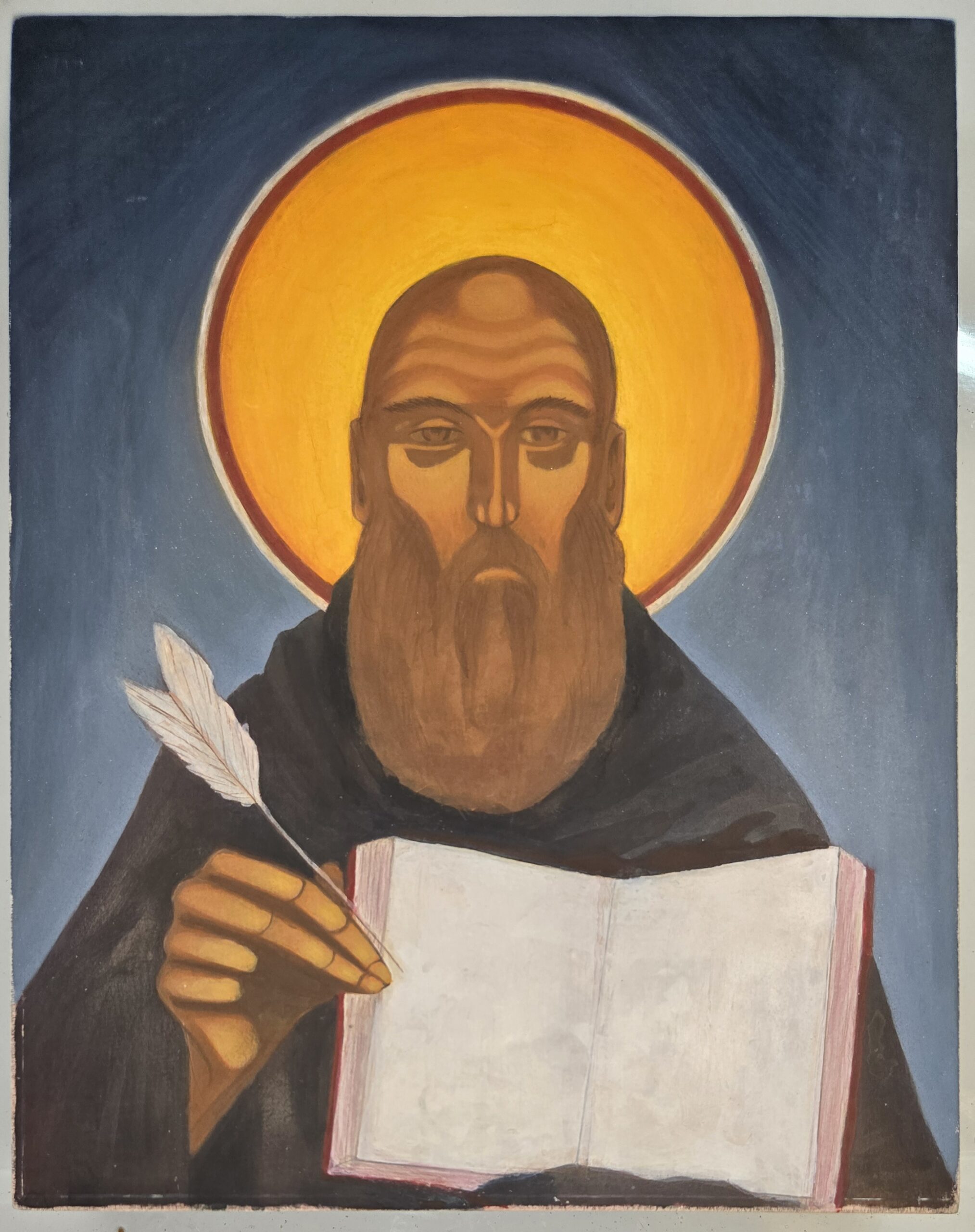
St. Eadfrith
St. Eadfrith represents the holiness of quiet faithfulness and disciplined attention. Through him, God reveals that beauty, patience, and craftsmanship can become acts of prayer. His central virtues are humility, devotion, and perseverance. Rather than seeking power or recognition, Eadfrith spent his life in steady labor: copying sacred texts, praying, studying, and shaping beauty in service to God.
He witnesses Christ through reverence for the Word made visible. In the Lindisfarne Gospels, the Gospel message is not merely written, but illuminated with care, order, and love. His life reflects the hidden years of faithful work that often shape the world more deeply than public greatness.
The Church venerates St. Eadfrith because he transformed artistic labor into sacred offering. His work preserved the Christian faith during a fragile time in early medieval England and became one of the great treasures of Christian civilization.
His life speaks powerfully to modern people living in an age of speed, distraction, and constant noise. Eadfrith reminds us that holiness is often formed slowly: through attention, repetition, silence, and devotion to meaningful work done faithfully over time.
Extended Iconographer’s Notes
St. Eadfrith is shown wearing simple monastic garments rather than elaborate episcopal vestments, emphasizing humility, contemplation, and the disciplined life of prayer. His bald head and long beard reflect wisdom, age, ascetic practice, and spiritual maturity.
He holds a feather quill in his right hand and an open Gospel book in his left, identifying him as both bishop and scribe. The illuminated pages reference the Lindisfarne Gospels, the great manuscript traditionally attributed to his hand. Together, the quill and Gospel symbolize the transmission of divine truth through sacred labor, study, and craftsmanship.
The halo signifies sanctification and participation in divine light. The gold surrounding the halo represents heavenly reality and the uncreated light of God, while the blue background suggests contemplation, stillness, and spiritual depth.
The figure’s elongated proportions, frontal posture, and simplified geometry follow traditional Byzantine iconography, directing the viewer away from naturalistic portraiture and toward spiritual presence. Light appears to emerge from within the saint rather than falling upon him from an external source, reflecting the transfigured nature of holiness.
The setting is intentionally minimal, allowing the viewer’s attention to rest fully on the saint, the Gospel, and the quiet act of sacred writing.
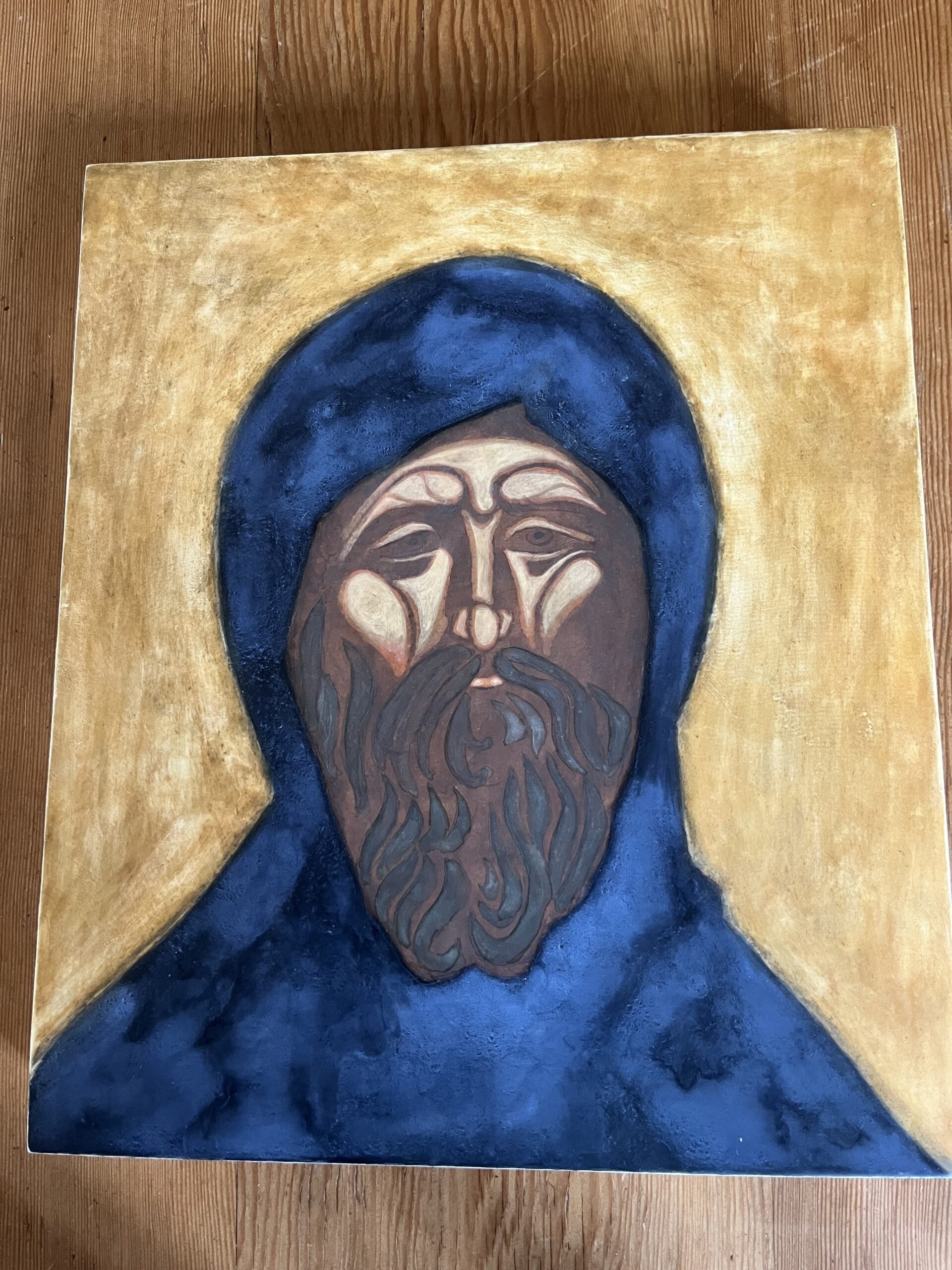
St. Anthony the Great
St. Anthony was born in a modest village in Egypt in 251 A.D. His Christian parents were well-born Egyptians, who owned considerable fertile farmland near the Nile. However, they died within months of each other when Anthony was perhaps 18, leaving him their estate, and the care of his much younger sister. About six months later, he was in church, and the passage read was Matthew 19:21: “Jesus said to him, ‘If you want to be perfect, go, sell what you have and give to the poor, and you will have treasure in heaven; and come, follow Me.’” Anthony felt these words were spoken directly to him, and he went out immediately and sold the estate, giving the proceeds to the poor, but keeping some for his sister. When he returned to church and heard, “Do not worry about tomorrow” (Matthew 6:34), he gave all that remained to the needy, entrusted his sister to a convent, and went to live by himself in a hut on the outskirts of town. Here, he worked quietly, making palm leaf mats, in order to buy himself bread and give to the needy. He began visiting men of zealous faith wherever he could find them, studying their habits and virtues.
The devil responded immediately, bringing to mind powerful memories of his past life, with its pleasures and responsibilities. When this failed to dissuade Anthony from his path, evil spirits confronted him in visible form – a seductive woman or a boy with a human voice. Anthony countered by eating only bread, salt, and water, sleeping very little, and praying as much as possible. He withdrew to an abandoned tomb, where demons in the form of beasts attacked him physically, and he was found unconscious on the ground. Finally, the roof opened, divine light poured in, and a voice said, “I was here, Anthony, watching your struggle, but I wanted to see your resistance. Since you have endured and not yielded, I will always be your helper, and I will make you renowned everywhere.” This strengthened him greatly.
Now about 35 years old, he crossed the Nile and found a deserted Roman fort near Pispir (modern Der el Memun), where he would spend the next 20 years in complete solitude. He stored bread for six months at a time, drank from a spring inside the fort, and saw no one. Spiritual warfare continued, with demonic assaults and temptations of all sorts; the demons often beat him violently. But Anthony resisted. Friends finally broke open the door of the fort, and were amazed when Anthony emerged in good health of both mind and body. Two decades of solitary reliance on God through terrible struggles had left him whole, balanced, and filled with the presence of God.
Word of his reappearance spread, and crowds began to seek him out for healing, deliverance, and wisdom. He taught as a spiritual father, and so many were persuaded to follow his way of life that, as St. Athanasius famously wrote, “the desert became a city.”
Seeking quiet, he moved near the remote desert peak of Mt. Colzim, where he lived the last 45 years of his life, receiving pilgrims and healing the sick. He left this outpost briefly during the great persecution of 311, visiting Alexandria to help and encourage those being martyred for their faith. He went again in 338, at the request of the bishop, to refute the heresy of Arianism. “The man of God” (as everyone called him) taught clearly and boldly, and people received healing and deliverance right in front of the skeptical philosophers. Many converted on the spot. Although Anthony was unlettered, his reputation for wisdom grew, so that even the Emperor Constantine and his sons wrote him letters seeking counsel. He advised them to remember Christ, consider the coming judgment, and show mercy and justice to the poor.
In spite of his ascetic lifestyle, which he never relaxed, his body remained free of injury, his eyesight sharp, and he kept all his teeth (although worn to the gum) until he died peacefully at 105.
St. Athanasius, Patriarch of Alexandria, wrote a biography of Anthony immediately after his death. It was soon translated into Latin, and became something of a bestseller, inspiring the conversion of St. Augustine of Hippo, among others. Anthony’s influence on monastic life was profound.
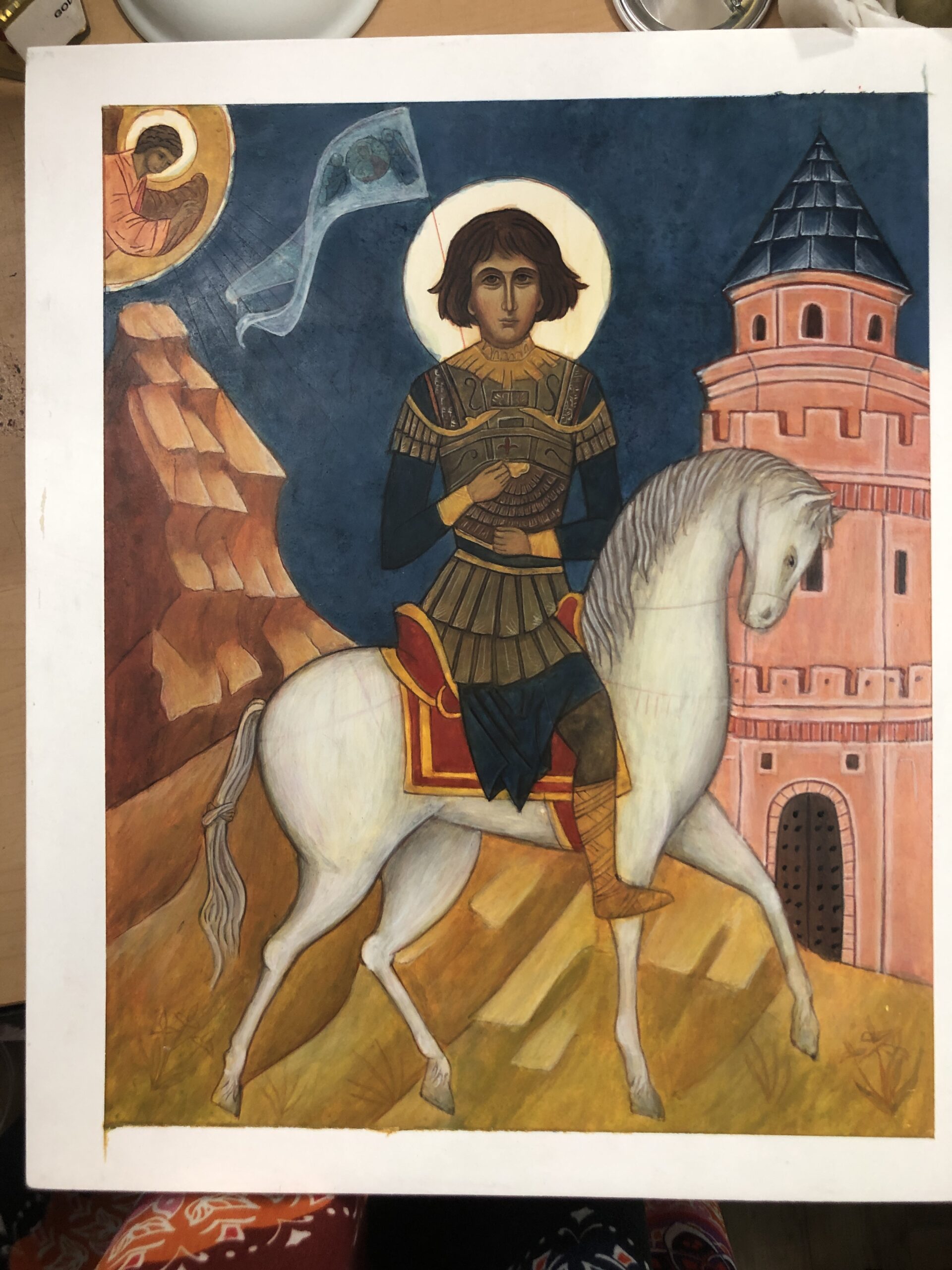
St. Joan of Arc, Maid of Orleans
Born around 1412 in Domrémy, France, Joan was a simple farm girl, living during the Hundred Years’ War, when France was torn apart by the invading English.
At the age of 13 while praying in the garden, she had a vision of St. Michael, St. Catherine, and St. Margaret, calling for her to be a good girl, go to church regularly, and prepare for the divine mission of driving the English out of France and seeing the Dauphin crowned king.
Joan had no training or skills to lead an army, but she was obedient to her God and moved forward with unshakable courage. At the age of 17, she traveled to Chinon to meet the Dauphin Charles. Her unwavering faith convinced him of her divine calling, and he granted her command of an army to reclaim Orléans. To maintain her chastity while traveling with soldiers, Joan cropped her hair and wore men’s armor. During the Siege of Orléans, she led the charge on a white horse, waving a handmade banner to inspire her troops. Just nine days after her arrival, the siege was broken, and the enemy retreated. She had led France to victory.
In July of 1429, Joan attended the coronation of King Charles VII of France. Upon seeing Charles crowned, Joan knelt and embraced his legs, proclaiming that God’s will had been fulfilled.
The next year brought Joan’s greatest struggle. She was captured by the Burgundians and sold to the English. Joan was dragged before an ecclesiastical court and accused of heresy and cross-dressing. Abandoned by her king and facing the terrifying prospect of execution by fire, Joan remained steadfast in her faith, refusing to deny that her visions had been from God. She knew her mission was divine, and even death could not shake her faith.
At the age of 19, she was burned at the stake.
A posthumous retrial declared her innocent twenty-five years later, and she was canonized in 1920. Today, St. Joan of Arc is revered as a national heroine of France, a Catholic saint, and a symbol of courage and faith.
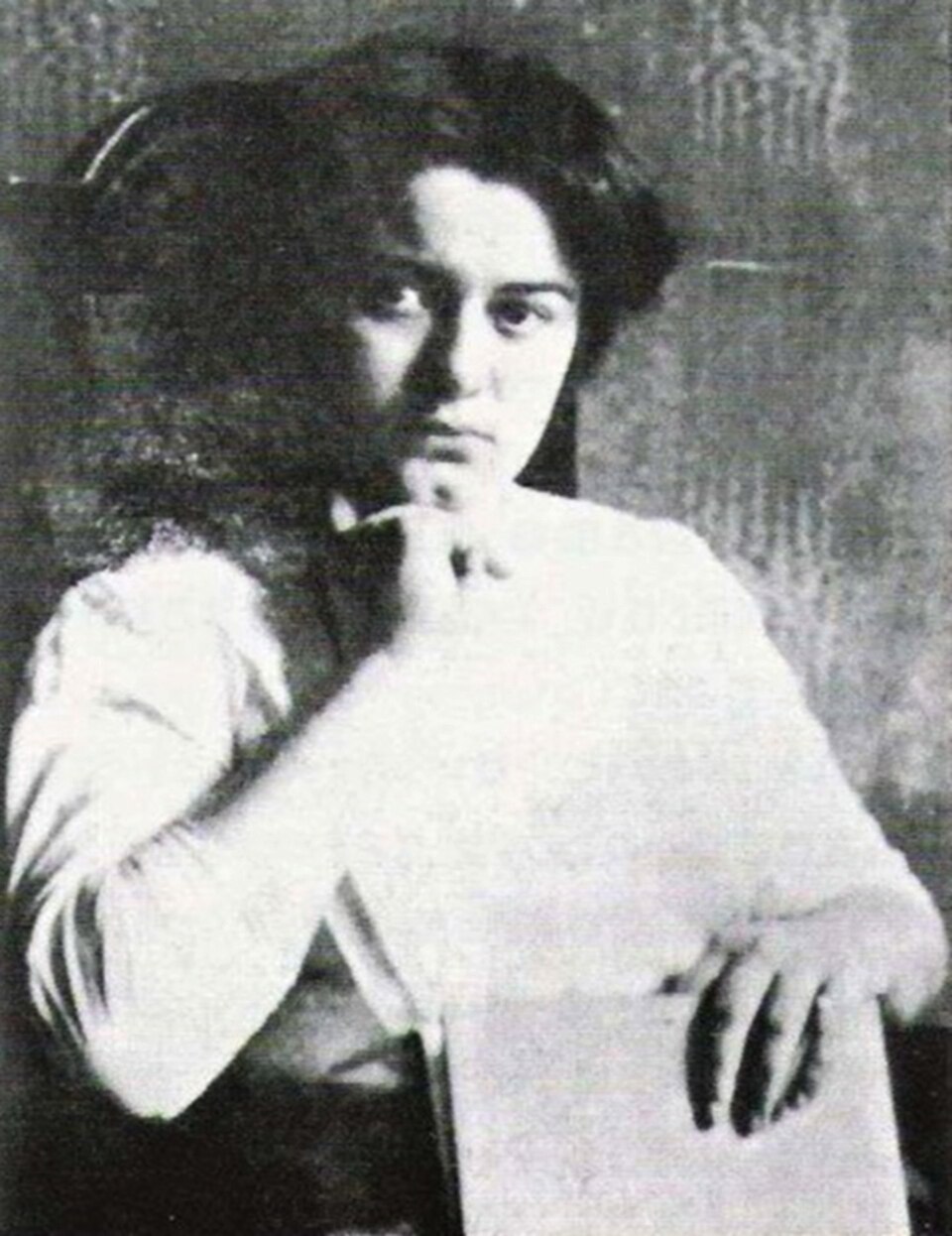
Edith Stein, student at Breslau (1913-1914)
St. Teresa Benedicta of the Cross
Edith Stein was a prolific writer, translator, and lecturer on such varied topics ranging from phenomenology—her particular expertise in philosophy—to theology, education, and the role of women in national life and in the Church. We have so much to learn from her that is relevant to the needs of our own day! Yet the essence of her message was the Cross of Christ. She gave witness in word and deed to a life totally surrendered to God’s will, in complete trust in His Divine love and providence. St.Teresa Benedicta’s greatest act of surrender was to “joyfully accept” the death she anticipated would come as a Jew living in Nazi-controlled Europe. She viewed this as the Cross she was called to bear and offered both her life and her death to God—“for the honor and glory of his name, for the needs of his holy Church…for the Jewish people…for the deliverance of Germany and peace throughout the world…for all my relatives living and dead and all whom God has given me…”

Saint Therese of Lisieux, Doctor of the Church
Also known as St. Therese of the Child Jesus and the Holy Face
Marie Françoise-Therese Martin was the ninth child of Louis and Zelie Martin, born in Alençon, Normandy, France. The Martins were devout Catholics, attending daily Mass and observing fasts and feasts. In fact, Louis and Zelie are the first married couple declared Saints, canonized by Pope Francis in 2015. Four of Therese’s siblings died in infancy or early childhood, and the remaining five daughters all dedicated their lives to Jesus as monastics, four as Carmelites at the abbey in Lisieux, and her sister Leonie as a member of the Visitation Sisters in Caen, France.
As a child, Therese wished more than anything to become a Saint, and with her cousin and sister, she played at being an anchorite. At age 14, she revealed to her father her wish to become a nun, and they went on pilgrimage to Rome where she met Pope Leo XIII. Therese begged him to allow her to enter the Carmel at Lisieux. Despite many initial barriers, Therese was only 15 years old when she entered the Carmel as a postulant. She progressed as a novice and, at her veiling, took the name Therese of the Child Jesus and the Holy Face. She lived in the Carmel with her Sisters until she was 24 years old, when she died of tuberculosis.
As a Carmelite, Therese wrote many poems and plays of adoration and in the last years of her short life, she was encouraged by her two eldest sisters to write a memoir of her childhood and a chapter relating to her spiritual development. She was very hesitant to write anything of herself or her ideas as she didn’t think it was becoming of a nun to do so, but she obeyed nonetheless. Her writing was distributed after her death as a book entitled The Story of a Soul, which has become a vital element in the canon of the Church.
In The Story of a Soul, she describes herself as a “little flower,” and illustrates her Little Way, for which she is most loved and well-known. Therese was very aware of her insignificance and realized it necessitated small ways of being holy. She writes that she is no more like a real Saint “than a grain of sand trodden beneath the feet of passers-by is like a mountain with its summit lost in the clouds.” Because of her “littleness,” she had to find a different way to get to Heaven than the miraculous works and blazing visions attributed to “real’ Saints. She learned to deny herself and do small things with great love, hoping that Jesus would carry her in the “elevator” of His loving arms to spiritual heights that she could not reach on her own.
Saint Therese is one of the four female Doctors of the Church. She was beatified only 26 years after her death and canonized two years later, both promotions by Pope Pius XI. She was made a Doctor of the Church by Pope Saint John Paul II in 1997.
Iconographer’s Notes
In icons of Saint Therese, she is often portrayed with roses and when miracles started happening that were attributed to her, they were often accompanied by roses. In her writing, however, she describes herself as a “little flower” and likens herself more to a violet or a daisy, saying that not everyone can be a rose or a lily. I chose a daisy for this icon because I love Therese’s littleness and humanity. For example, she wasn’t very good at chores or handiwork in the convent, and she fell asleep during prayers in the chapel. Her greatness came through her dedication to denying herself and doing small things with great love for others.
Therese was the youngest in her family and, as a child, sensitive, proud, and impetuous. Even as a young adult, she challenged God in funny, childish ways. She writes about a time in which the Carmel was running short on Eucharistic Hosts, and she was tired of getting only fragments at Holy Communion. She decided that one particular day, if she went to Holy Communion and only got part of a Host, she would “know that Jesus does not really want to come into my heart.” When she went up to receive, the priest surprised himself by giving Therese TWO COMPLETE HOSTS! I love this story because I myself have set tests for God, and He has always responded with love and generosity despite my foolishness. In this icon, Therese extends her right hand with two Hosts, encouraging us to experience the saving love of Jesus and His deep desire to abide in us.
While Saints are most often portrayed in their monastic garb, Therese asked to be dressed as a bride for this icon. In her writing she regularly addressed Jesus as her divine Spouse, and made much of her decision to marry herself to Our Lord. The white of her dress and veil, as for all brides, represents purity and St. Therese’s transfigured state after her death.