Pedagogical & Technical Rationale
Pedagogical Method
The Classical Iconography Institute follows a traditional master–apprentice pedagogical model repeating the historical way in which sacred arts were handed down. Instruction emphasizes observation, disciplined repetition, and faithful adherence to canonical forms. Students learn through demonstration, guided practice, critique, and revision with the intention to form technical competence, humility, patience, and discernment. Progression from one level to the next is intentional and cumulative; each level presumes understanding of the previous, ensuring that students are formed gradually over time with practice within the tradition they are entrusted to serve.
Liturgical Orientation
Icons are not autonomous art, but visual theology offered to the Church. Each icon in the program is selected not only for pedagogical clarity, but for its liturgical and devotional role. Students are formed to understand icons as painted prayer, proclamation, and encounter—created in obedience to the Church’s received tradition and intended for veneration, not self-expression. This orientation safeguards both the integrity of the icon and the spiritual responsibility of the iconographer.
Iconography forms the whole person through stillness, attentiveness and interior reflection. As the hand learns obedience to form, the heart learns obedience to truth. In this way, the practice of iconography becomes ascetical, aligning artistic labor with spiritual growth.
Why Did We Choose The Following Four Icons?
The Institute’s first four icons in Level I introduce students to a basic grammatical range of Byzantine visual language: frontal and three-quarter views, male and female physiognomy, stillness and gesture, authority and supplication, divine glory and ascetic poverty. By the conclusion of the fourth icon, students have encountered the primary iconographic structures necessary to read, understand, and responsibly create icons within the tradition.
Classical Iconography Institute’s Responsibility
The Classical Iconography Institute strives to be a steward of an ancient, living tradition through preservation and education. This pedagogical sequence reflects a responsibility to transmit iconography faithfully, clearly, and prayerfully to the next generation. By anchoring instruction in classical iconography that molded the tradition, technical rigor, and spiritual formation, the Institute ensures that students are equipped not only to paint icons, but to safeguard the integrity of classical Byzantine sacred iconography for the Church and the world.
In the Beginning
Level I – The Holy Mandylion

Christ is the first icon.
The Holy Mandylion—the Icon Not Made by Human Hands—confesses that Christ did not come merely to walk among us but revealed His very face to the world. Before that night in Bethlehem, God could not be depicted because He was unseen. Through the Incarnation, He became visible—seen with human eyes. The Mandylion is a sacred image that did not arise from imagination, but from human encounter.
We proclaim this mystery that changed everything: the invisible God became visible. This is why icons exist. This is also why the Icon Not Made by Human Hands is the first icon taught in our program.
Christ underlies every icon, and therefore deepening this relationship is an essential first step.
“The invisible things of God have been made visible” through the Incarnation, allowing us to represent Christ. ~ St. John of Damascus
Transformation Through Contemplation
St. Gregory of Nyssa proclaimed that gazing upon the Holy Face allows the believer to receive the image of Him, transforming the believer into His likeness.
Since with all my soul I behold the face of my beloved, therefore, all the beauty of His form is seen in me. ~ St. Gregory of Nyssa
This icon connects both East and West, with ties to the Veil of Veronica and the Shroud of Turin.
Technical skills. From a technical perspective, the Holy Mandylion helps us teach this liturgical art by focusing on a large, fully frontal face, giving us space to show how to form the facial masses, the facial features, hair, beard and mustache, while simultaneously learning how we make pigment from egg yolk, vinegar and ground minerals/earth. Students learn line work, different styles of brushwork, paintbrush control, and how to use water. Additionally, we teach the meaning of the inscription, how to render it, and mordant gilding. We teach in 14 weeks what apprentices of antiquity learned in years, so a commitment to active participation is important.
Objective: To Create a Home Altar (Deisis)
What is a “deisis”? Deisis is a Greek word meaning “prayer” or “supplication” and in in Eastern Christianity, it is a sequence depicting Christ Pantocrator enthroned, flanked by the Virgin Mary (on His right) and St. John the Baptist (on His left). Both the Virgin Mary and St. John the Baptist are shown as supplicants, gesturing in prayer or intercession for humanity to Christ. These three essential images form part of an iconostasis screen found above the “royal doors” of an Orthodox church, and are also used as standalone votive icons, as they would be in your home altar.
They represent Christ as judge and mediator with the Virgin Mary and St. John the Baptist functioning as primary intercessors for humanity’s salvation.
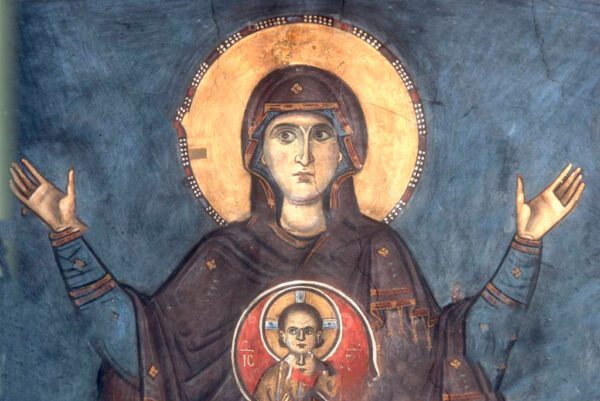
Level II – The Hagiosoritissa
The Theotokos, or Mother of God is shown in her role as intercessor, which is why her hands are outstretched before her. The Virgin Mary is offering prayers on behalf of humanity to her Son.
Technical skills. Students learn how to paint a smaller, ¾ turned female face, hands, a female head covering/veil and a basic garment with decorative elements (stars).
Level III – Christ Pantocrator
Christ, Pantocrator or Ruler of All is central to the salvation plan in the deisis where he is shown as merciful, and judge, blessing us with His right hand and holding the law (Gospel) in his left.
Technical skills. Students learn how to paint two additional variations of the hand – the blessing hand and the hand holding a book, a book in inverse perspective, inner and outer garments of Christ, advanced highlighting techniques and methods of painting hair.
Level IV – St. John the Baptist
St. John the Baptist, mirrors the Virgin Mary’s posture as supplicant and is depicted in his traditional blue-green camel hair shirt, with wild hair and ascetic appearance.
Technical skills. Students learn a new approach to painting sankir (the flesh tones) and how to depict the special physical characteristics of an ascetic.
A Systematic Journey
Together, these four beginning level icons form a deliberate and integrated pedagogical path that mirrors the theological logic of the Incarnation and spiritual formation of the iconographer. The Holy Mandylion grounds the student in the foundational truth that icons exist because God became visible; it establishes Christ as the source and purpose of all sacred images.
The Theotokos as Intercessor introduces the relational aspect of iconography—how humanity responds to Christ through prayer, obedience, and mediation—while learning how to convey sensitivity, gesture and reverence.
The Pantocrator presents Christ as Ruler of All simultaneously. This is not conveyed through narrative, but through balance: the stillness of the frontal gaze and restraint of expression.
Finally, St. John the Baptist completes the deisis and beginning level curriculum by embodying prophetic witness, ascetic transformation, and radical humility, entreating both painter and viewer to repentance and preparation of the heart.
This sequence is intended to be both instructive and formative. Each icon builds upon the last, deepening understanding while progressively expanding technical skills. We hope it manifests through an inward transformation—training the human eye and the eye of the heart to see, the hand to serve faithfully, and the heart to be conformed to Christ. In this way, the program does not simply teach students how to paint icons; it teaches them how to convey visual theology, so that their icons may truly become windows into transcendence.
Ways to Learn
14-Week Courses & Summer Retreats
Each level is structured as a 14-week program offered in-person throughout the year in our Studio at St. Pius X Catholic Church in Portland. The Institute is beta testing an online painting course for future release.
Each level is also offered in the summer during a one-week intensive residential retreat at the Benedictine Mount Angel Abbey.
All levels of our Byzantine Drawing Program are offered in both 14-week format in-person and online formats.
Sacred Art Pilgrimages
Every two years, the Institute offers an immersive opportunity to experience ancient iconography in-person through pilgrimages to historically significant sacred sites throughout the world. Learn more by visiting the institute website and selecting “Tours.”