

The Holy Mandylion—the Icon Not Made by Human Hands—confesses that Christ did not come merely to walk among us but revealed His very face to the world. Before that night in Bethlehem, God could not be depicted because He was unseen. Through the Incarnation, He became visible—seen with human eyes. The Mandylion is a sacred image that did not arise from imagination, but from human encounter.
We proclaim this mystery that changed everything: the invisible God became visible. This is why icons exist. This is also why the Icon Not Made by Human Hands is the first icon taught in our program. Christ underlies every icon, and therefore deepening this relationship is an essential first step.
“The invisible things of God have been made visible” through the Incarnation, allowing us to represent Christ. St. John of Damascus
Transformation through contemplation. St. Gregory of Nyssa proclaimed that gazing upon the Holy Face allows the believer to receive the image of Him, transforming the believer into His likeness.
“Since with all my soul I behold the face of my beloved, therefore, all the beauty of His form is seen in me.” St. Gregory of Nyssa
Technical skills. From a technical perspective, the Holy Mandylion additionally helps us this liturgical art by focusing on a fully frontal face, how to form the flesh tone, the facial masses, the facial features, hair, beard and mustache, while also teaching the universal applicable skills of inscription and gilding.
The Next Step – Level II
The next Level II in our program focuses on The Theotokos, or Mother of God, specifically as intercessor, which is why her hands are outstretched before her. The Virgin Mary is offering her prayers on behalf of humanity to her Son, who in this arrangement is to her left (our right).
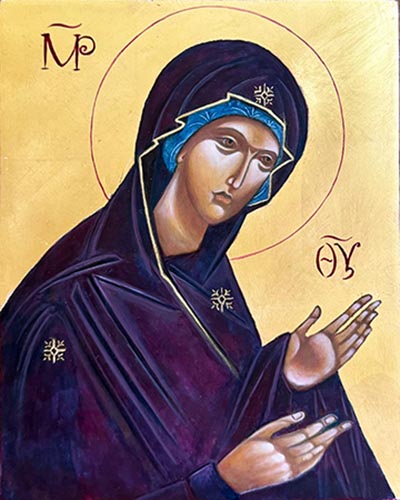
Technical skills. Students learn how to paint a smaller, 3/4 turned female face, hands, head covering and a basic garment with decorative elements (stars).
Level III – Christ Pantocrator
The traditional Deisis composition in Eastern Orthodox Christianity features Christ Pantocrator in the center, the Virgin Mary (Theotokos) on His right and St. John the Baptist on His left, both with hands raised in entreaty for humanity. Level III creates the center of your home altar or deisis.
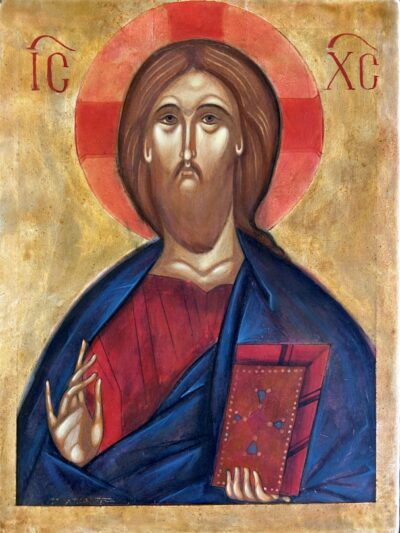
Technical skills. Students learn how to paint the blessing hand, the hand holding a book, a book in inverse perspective, inner and outer garments of Christ, and advanced highlight techniques and methods of painting hair.
Level IV – St. John the Baptist
The third element of the traditional Deisis, creates a complete home altar with St. John the Baptist, depicted in his camel hair shirt, with wild hair and ascetic appearance.
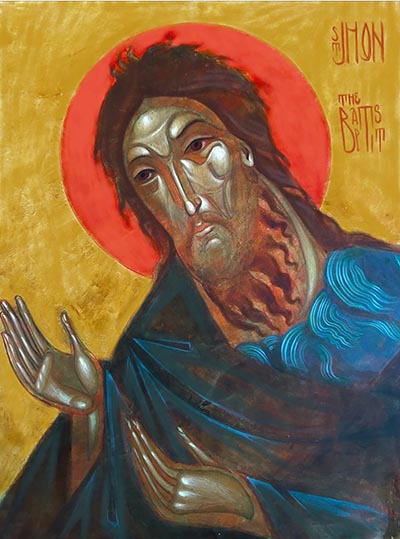
Technical skills. Students learn a new approach to painting sankir (the flesh tones) and how to depict the special physical characteristics of an ascetic.
A Coherent Pedagogical and Theological Journey
Together, these four icons form a deliberate and integrated pedagogical path that mirrors both the theological logic of the Incarnation and the spiritual formation of the iconographer. The Holy Mandylion grounds the student in the foundational truth that icons exist because God became visible; it establishes Christ as the source, measure, and purpose of all sacred images.
The Theotokos as Intercessor introduces the relational aspect of iconography—how humanity responds to Christ through prayer, obedience, and mediation—while refining sensitivity to gesture, proportion, and reverence.
The Pantocrator presents Christ as Ruler of All and Lover of Mankind simultaneously. This is not conveyed through narrative, but through balance: the stillness of the frontal gaze, the restraint of the expression, the measured symmetry of the face. The iconographer must resist exaggeration—neither softening Christ into sentimentality nor hardening Him into severity.
Finally, St. John the Baptist completes the Deisis and the curriculum by embodying prophetic witness, ascetic transformation, and radical humility, calling both the painter and the viewer to repentance and preparation of the heart.
This sequence is not merely instructional but formational. Each icon builds upon the last, deepening theological understanding while progressively expanding technical skill. More importantly, it shapes the iconographer inwardly—training the eye to see, the hand to serve faithfully, and the heart to be conformed to Christ. In this way, the program does not simply teach students how to paint icons; it teaches them how to enter the Church’s visual theology, so that their work may truly become a window into transcendence.
Each level is offered as a 14 week program, and also as a one-week intensive residential retreat option at Mount Angel Abbey in the summer.

Leave A Comment
You must be logged in to post a comment.