
Thank you for visiting AVE!
We’re so glad you joined us for the Marian icon exhibit. We hope it deepened your appreciation for this sacred and timeless art form!
If you’re feeling inspired and want to learn more, the Classical Iconography Institute offers training for those called to the work of writing liturgical icons. Our approach is rooted in tradition: students study not just technique, but also the theology, history, and symbolic meaning behind each saint or subject. We explore how these holy images have been depicted through the centuries and how they can speak to today’s faithful.
Whether you’re new to art or experienced with a brush, you’re welcome here. No prior art skills are required. Visit our CLASSES pages to learn how you can start your journey into becoming an iconographer.
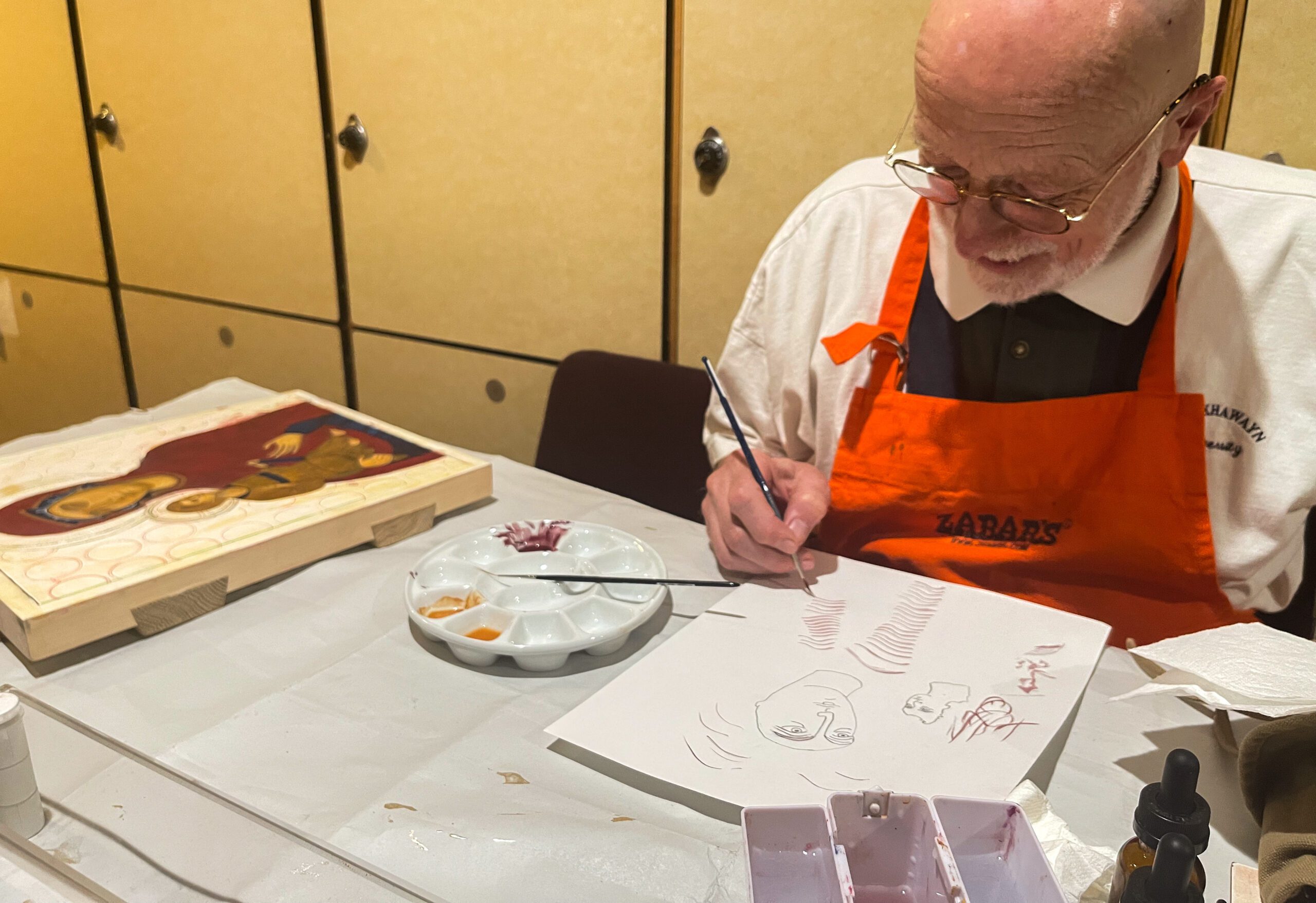
Here is more information about Marian Icons:
How many different kinds of Marian icons are there?
There are many different kinds of Marian icons, each depicting the Virgin Mary in a unique way that reflects different aspects of her life, role, and relationship with Christ and the Church. These icons serve as visual theology, expressing deep spiritual truths through posture, gesture, and symbolism. Over centuries, certain traditional types have become widely recognized, each with its own name and iconographic features. Some of the most well-known types include:
(mobile users: swipe to see the themes and examples of each icon)
NAME OF GENRE |
THEME |
EXAMPLE |
|---|---|---|
Hodegetria |
Mary points to Christ as the way | 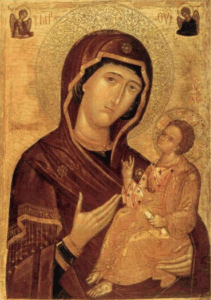 |
Eleousa orGlykophilousa |
Tenderness, Incarnation, Passion | 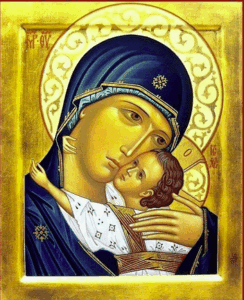 |
Oranta or Sign |
Incarnation in womb, intercession | 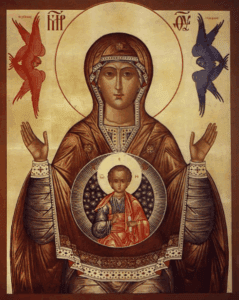 |
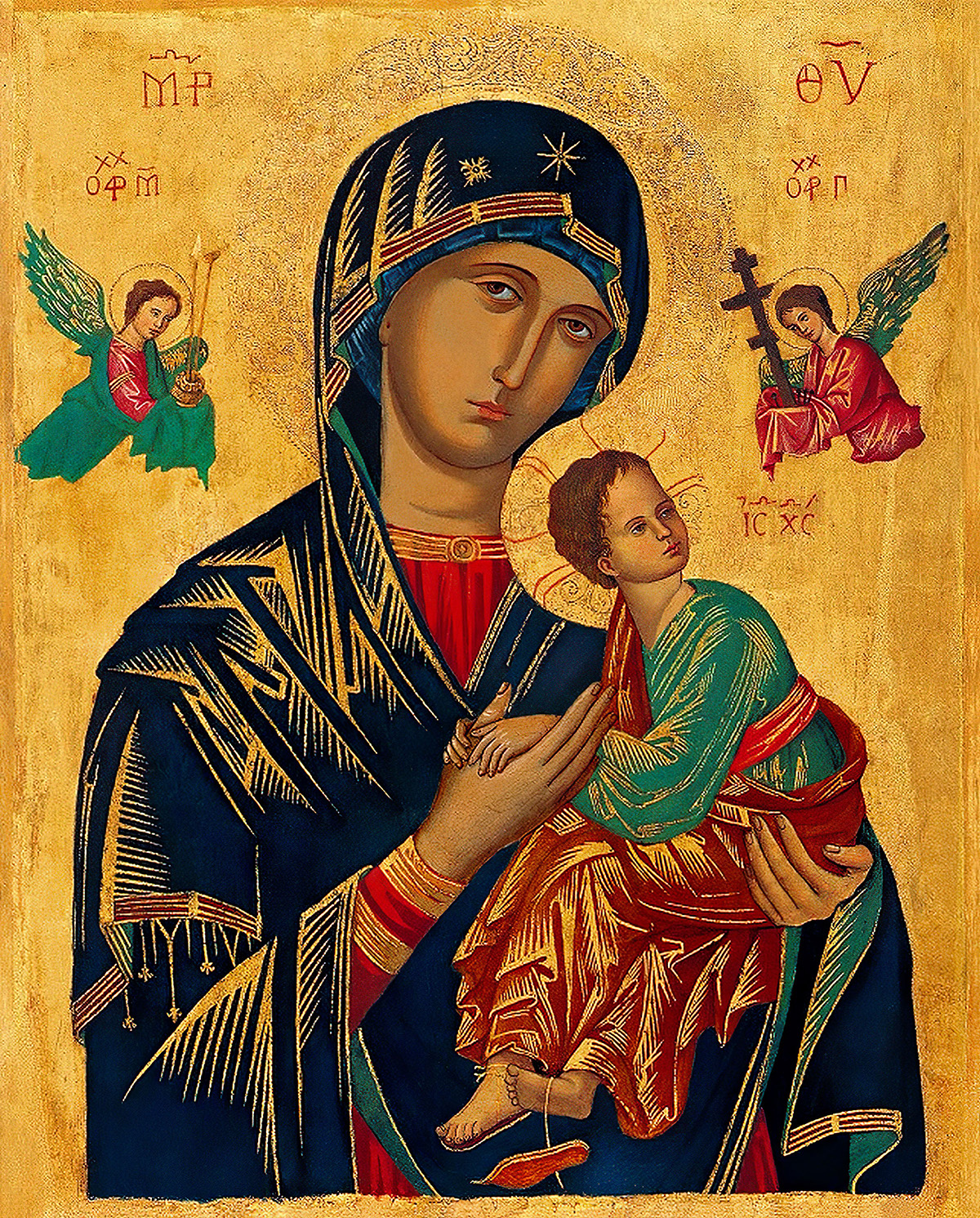
Passion or Perpetual Help |
Redemption, fear of suffering | 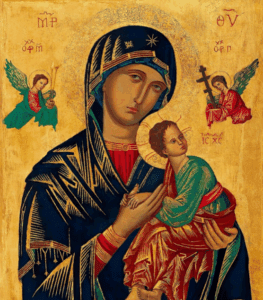 |
Kecharitomene |
Full of grace, purity | 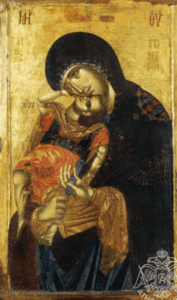 |
Protecting Veil |
Intercession, protection | 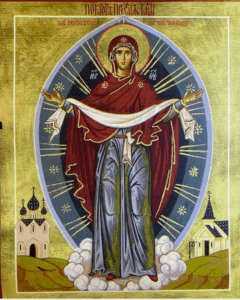 |
Kardiotissa |
Compassion, sorrow | 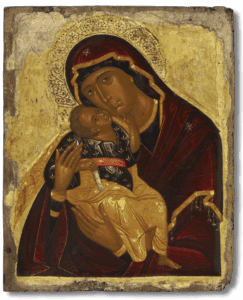 |
Enthroned Madonna |
Mary’s queenship, heavenly majesty | 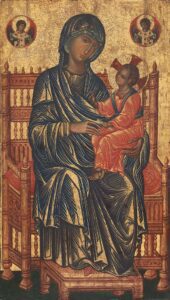 |
Dormition |
Peaceful death and assumption | 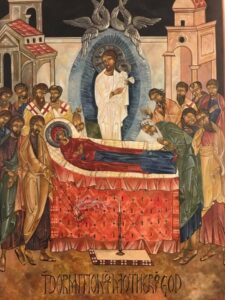 |
What is the oldest icon or image of Mary?
Rather than focusing on when the first Marian image appeared (which is a matter of some debate!) it’s more helpful to look at the oldest known examples we have today.
One of the earliest surviving images of Mary is found in the Catacomb of Priscilla in Rome. In this fresco, Mary is shown holding the Christ Child on her lap. This depiction, often referred to as the Madonna, offers a glimpse into early Christian devotion to Mary, though it is not considered an icon in the formal sense.
The oldest surviving Marian icon, in the traditional sense of an icon painted on a panel, is housed at St. Catherine’s Monastery at Mount Sinai. This icon portrays the Virgin Mary holding the Christ Child and flanked by saints and angels. It is a remarkable example of early Byzantine iconography and dates to the 6th century.
According to tradition, St. Luke the Evangelist is believed to have painted the first image of Mary and Christ, and while no original by Luke has been authenticated, this belief profoundly shaped the development of Marian iconography. Many cultures and churches even claim to possess the image he supposedly created.
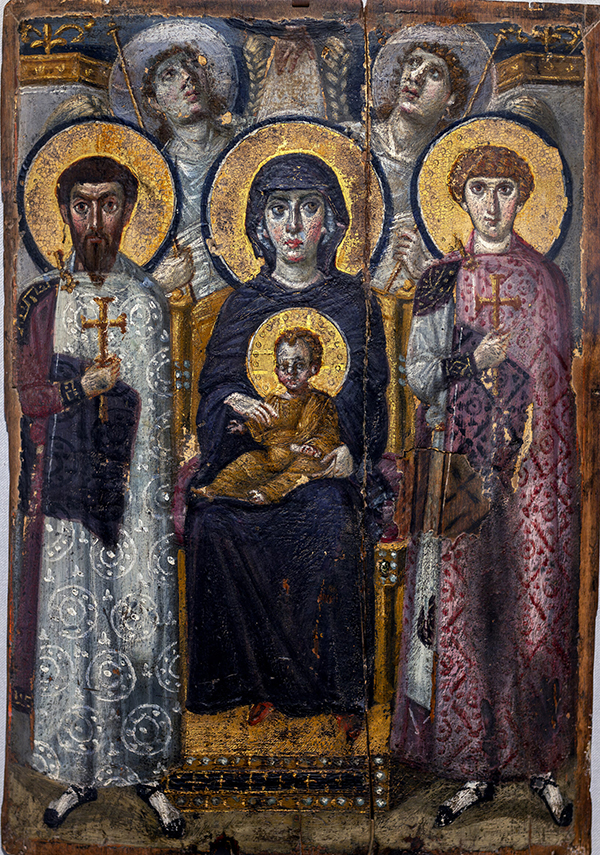
Theotokos Enthroned Icon
One of the oldest surviving icons is at Saint Catherine's Monastery on Mount Sinai. It is a 6th-century encaustic painting featuring the Virgin Mary seated on a throne, holding the Christ Child, and flanked by Saints Theodore and George.
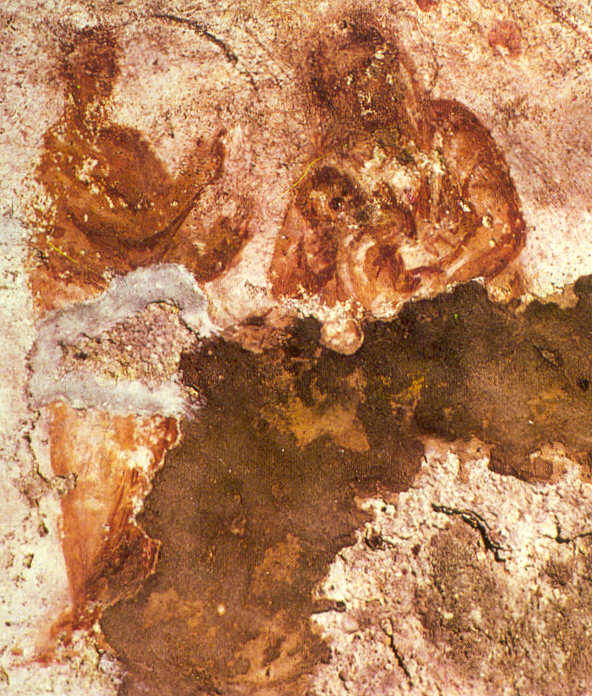
The Priscilla catacombs image
The Priscilla catacombs may contain the oldest known Marian paintings, from the early third century. Mary is shown with Jesus on her lap.
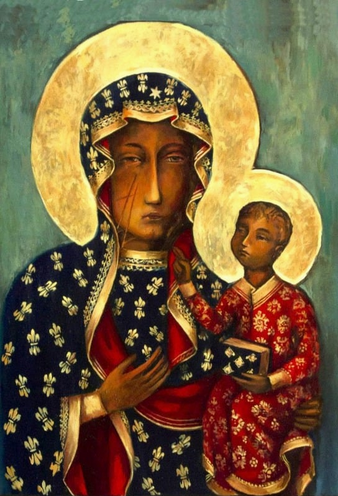
Our Lady of Czestochowa and St. Luke the Evangelist
According to tradition, St. Luke—both Gospel writer and physician—was the first to paint the image of the Virgin Mary, capturing her likeness from life. This beloved icon, known as the Black Madonna of Czestochowa, is said to be one of those earliest depictions. Venerated for centuries, especially in Poland, the icon bears the marks of history, faith, and miraculous protection.
Why is Mary often dressed in blue and red?
Mary is often dressed in blue and red to show that she is both: human (blue), born of this world, humble and faithful AND glorified by God (red), chosen, filled with grace, and honored as the Mother of God.
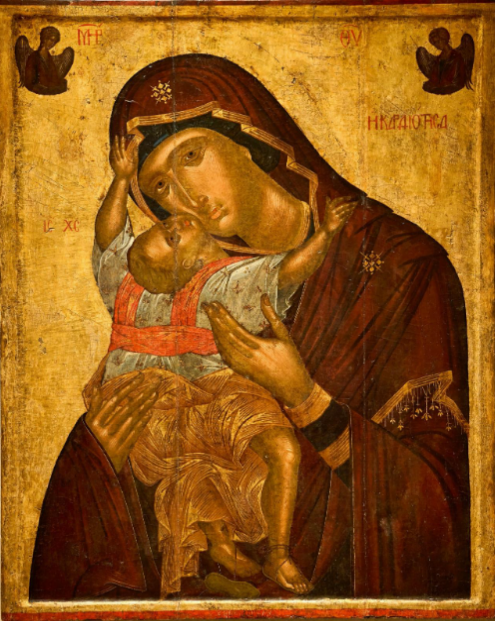
In Eastern (Byzantine) iconography, Mary is typically shown wearing:
A red or burgundy outer garment (mantle or maphorion), symbolizing divinity or heavenly grace; the idea that Mary was clothed in divine favor by God.
A blue inner tunic, symbolizing humanity, earthliness and her humble and fully human nature
This combination—red on the outside, blue underneath—expresses the belief that Mary was a human being (blue), who was chosen and transformed by God’s grace (red) to become the mother of Jesus Christ. It visually declares the mystery of the Incarnation—that the divine entered the world through human flesh.
In Western Art
In Western tradition, especially during the Renaissance, Mary is often shown in blue robes. Blue symbolized purity, peace, and the heavens.
The pigment ultramarine (made from lapis lazuli) was extremely expensive, so painting Mary in blue was a sign of honor and reverence.
Blue became closely associated with Mary’s role as the Queen of Heaven and as a model of humility
Vertical Axis
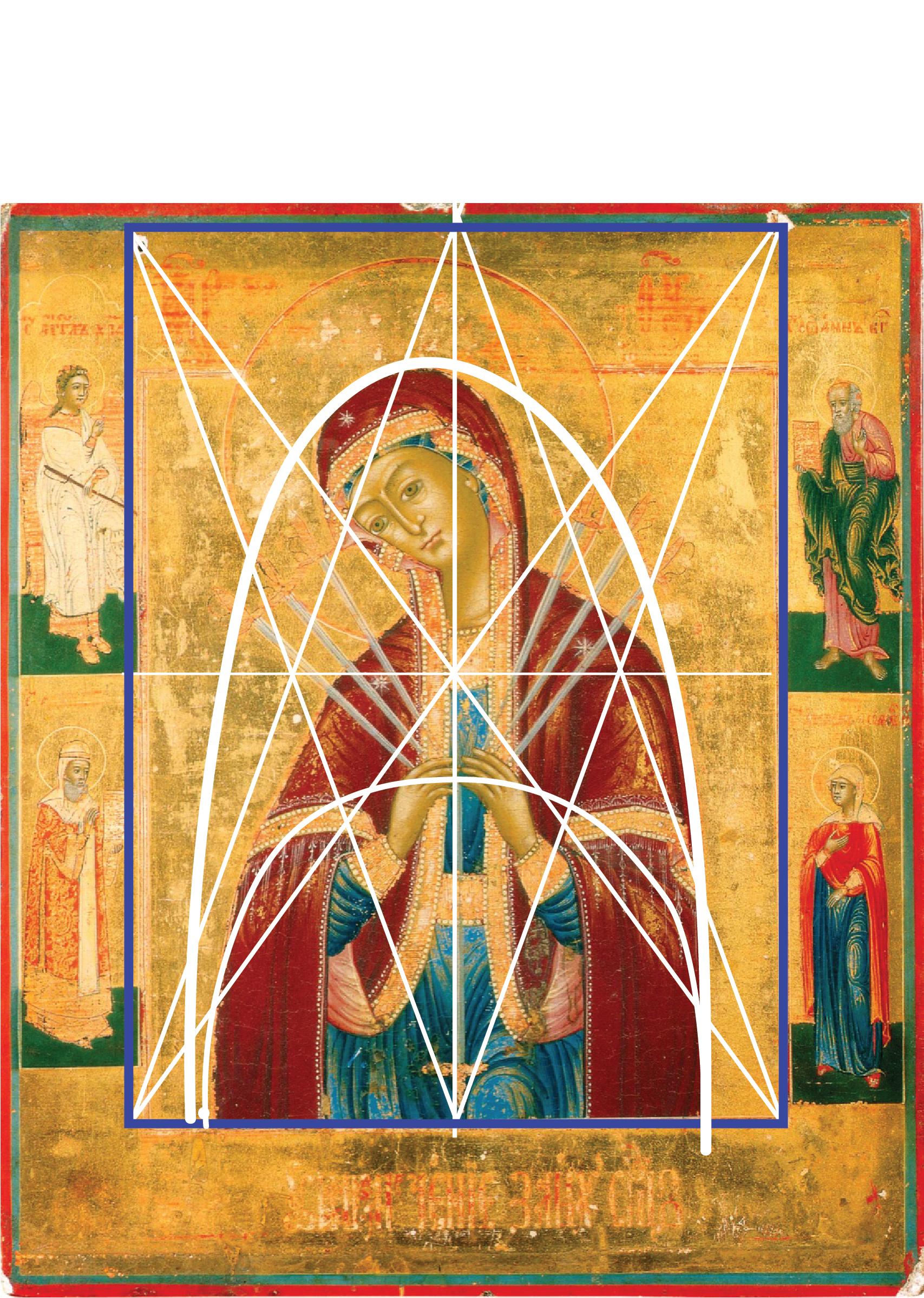
This icon of the Mother of God, Softening of Evil Hearts is visually and theologically distinct, with a unique geometry unlike most other Marian icons. Mary is shown without the Christ Child, her expression solemn and sorrowful, and her heart is pierced by seven swords that are symbols of profound grief and prophetic sorrow.
A strong vertical axis runs through the center of the composition, formed by the central sword that pierces her heart. This axis serves not only as a visual anchor, but also as a powerful symbol of Mary’s role as mediator between heaven and earth. It represents the spiritual channel through which divine mercy flows into the human world through her suffering and intercession.
The remaining swords arc outward in symmetrical formation, reinforcing the icon’s geometric harmony and focusing the viewer’s attention on her wounded heart. These piercing swords reflect the sorrows Mary endured, especially at the Passion of Christ, while also representing the ways in which she continues to intercede on behalf of those in pain or conflict.
Triangles

In the Hodegetria icon, Mary is depicted holding the Christ Child on one arm while gesturing toward Him with her other hand. Mary is shown as the one who leads the faithful to Christ, not the destination herself but the guide.
This icon often takes on a triangular composition, with Mary and Christ forming a visual triangle. Mary’s hand, her gaze, and her very posture all draw the viewer’s attention upward, toward Christ, the divine summit of the triangle. The triangle in iconography often represents the divine, and in this case, it emphasizes the central truth of the Incarnation: that through Mary, God entered the world.
Circles

In the Oranta or “Our Lady of the Sign” icon, Mary is shown in a frontal pose with her hands raised in prayer, a traditional gesture of intercession. At the center of her body is a circular mandorla containing the image of Christ Emmanuel, the child who is both God and man.
The circle, or mandorla, is a powerful symbol in iconography—it represents divine perfection, eternity, and the infinite. Placed within Mary’s womb, it proclaims the mystery of the Incarnation: God becoming flesh within time through her.
This icon follows a strong vertical axis, drawing the eye from Mary’s uplifted hands to the Christ child in the center. Mary herself becomes the living temple, the meeting place of heaven and earth. The Oranta doesn’t just depict a moment—it visually expresses a theological truth: through Mary, the eternal enters the world.
Hearts

The Kardiotissa icon, whose name means “She of the Heart,” is known for its emotional depth and intimate composition. Mary and the Christ Child are shown pressed closely together, often with their faces touching or nestled in a heart-shaped arc formed by their embrace.
This tender arrangement emphasizes centralized intimacy, drawing the viewer’s focus to the profound bond between mother and child. It is an icon of compassion, filled with feeling. Mary’s gaze is often sorrowful, as if already bearing the weight of her Son’s future suffering.
Vesica Piscis

The Protecting Veil, or Pokrov, icon shows Mary extending her veil in a broad, sheltering gesture over a group of people gathered below. The scene often takes place within a semicircular arc or vesica piscis shape. It is a symbol rich with spiritual meaning, evoking the meeting of heaven and earth, and the womb as a sacred space.
This icon visually emphasizes Mary’s role as protector and mediator. Her veil becomes a sign of divine shelter, stretched like a canopy between the heavenly and earthly realms. While she remains in a glorified state above, her presence remains deeply connected to those below, praying and interceding on their behalf.